Practical example

Teaching profession meets Lego. Collaborative digital education projects in primary schools

Teachers
Dr Dagmar Brand
Last update
University(s)
Subject group(s)
Target group(s)
Format | Mode

|

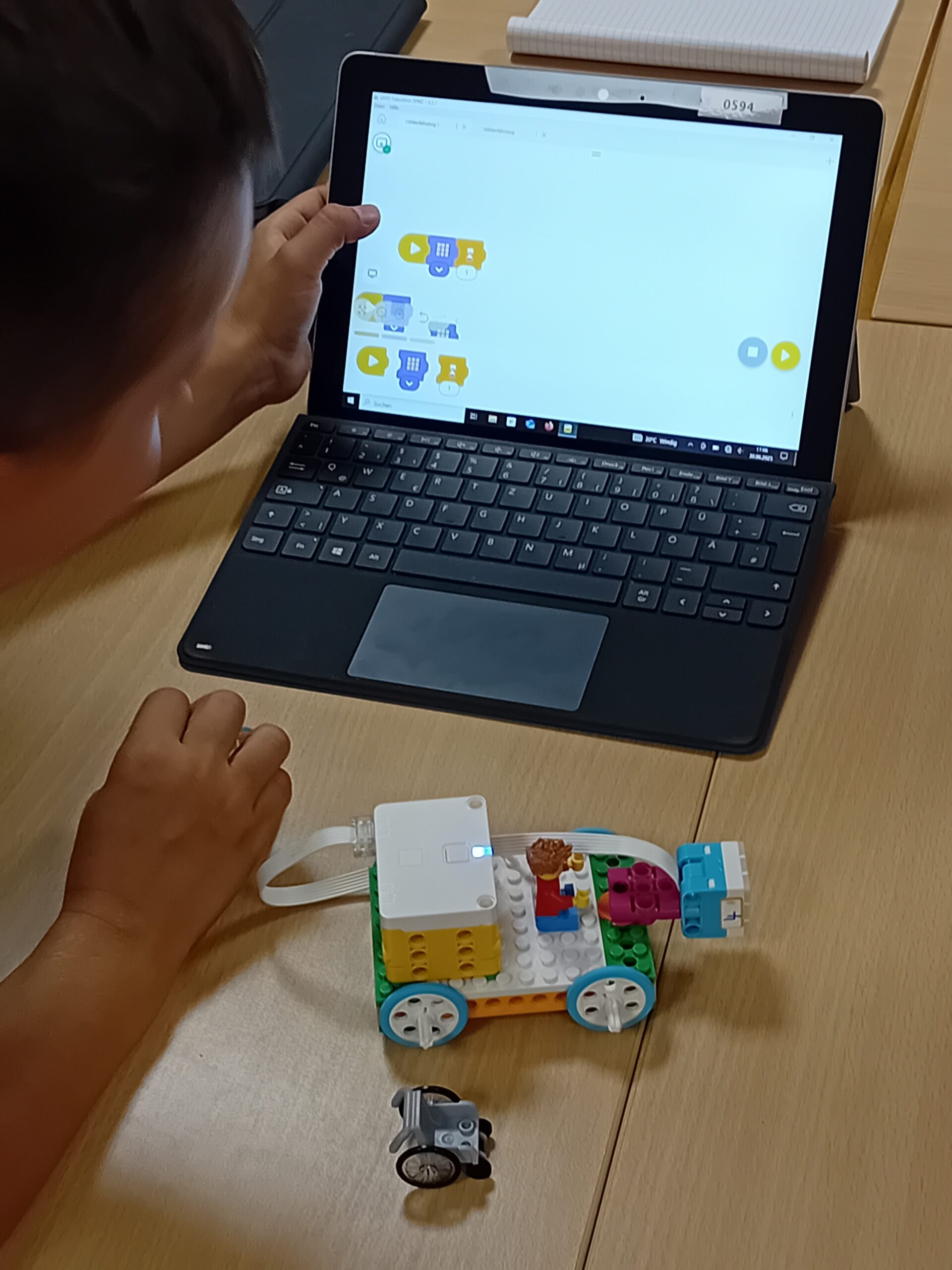
In the seminar of the same name, student teachers at the University of Erfurt are given the opportunity to try out practical media education with primary school children. There are two main topics to choose from, which are worked on collaboratively in groups: Topic 1: Building and experimenting with Circuit Cubes, Topic 2: Constructing and programming with Lego Education and Scratch.


The challenge of teaching

So far, this module has focussed on a more theoretical or practical research approach to topics of childhood and adolescence, which only partially included media education and digital education. In addition to the integration of digital education, the content is also expanded to include collaborative work and the trialling of teaching concepts in school practice.

Goals of your practical example

The aim of the newly designed course is for students to develop methodological and didactic approaches to teaching complex digital education topics such as programming with Scratch in conjunction with Lego Education© and Circuit Cubes©.
The seminar is to be offered regularly every semester in future. In addition, the cooperation with the project schools and the TU Ilmenau is to be continued and expanded in order to be able to offer further media and primary school-related courses with practical relevance.

Prerequisites for implementation

Material requirements: For the realisation, it was necessary to be equipped with the „tools“ (Lego and Circuit Cubes building sets) in class size. In addition, tablets could be borrowed from the „Workshop for Media Education“ at the University of Erfurt and all the technical equipment available there was tested by the students. Makey Makey was also purchased for the project.

Procedure

The pilot seminar was prepared and held in the summer semester of 2025. In an introductory block, the students were first given a methodological and didactic insight into digital educational arrangements, formed working teams on the two main topics of „Lego Education“ and „Circuit Cubes“ and were able to carry out an initial material exploration. In the newly created „Workshop for Media Education“ at UE, the students were given the opportunity to familiarise themselves with and try out various digital applications right from the start. The focus here was particularly on programming with Scratch and Makey Makey so that they could use them when creating lesson plans.
In the second step, the teams developed their own lesson plans in dialogue with the TU Ilmenau and in mutual coordination between the groups („group puzzle“). These concepts were presented, discussed and modified in the seminar.
The next step was to implement and test the teaching concepts. To this end, one team organised an excursion day to the TU Ilmenau to test the prepared learning units with children from a third grade class. Two other teams, who had been working on the main topic of Lego Education, were given the opportunity to test them at the Johannesplatz holiday centre. All three trial dates were scientifically monitored and evaluated by the project management in order to jointly reflect on the implementation of all teaching concepts in the final step.

Material for the practical example

The focus is on the creation of teaching concepts - tailored to the different conditions that the students encounter in practice. These include an excursion day for a third grade class to the TU Ilmenau and holiday projects for a heterogeneous group of primary school children at a primary school in Erfurt.

Photo from Lehrsetting

Helpful links and sources

Your suggestion or question

We hope that the practical examples will be viewed critically, utilised and developed further and thus remain alive. Therefore, please use the comment function to give your assessment of this practical example. Share your experiences in the implementation or refer to similar didactic methods (please include references or links). 

Your assessment will first be checked by us and then approved.

Leave a Reply

Your email address will not be published. Required fields are marked *

Contact person for the teaching concept

Bild von Claudia Hoffmann

Claudia Hoffmann

Contact us

Selection of topics