Practical example

Simulative learning and teaching as an innovative approach in distance learning programmes

Teachers
Prof Dr Bärbel Dangel
Last update
University(s)
Subject group(s)
Target group(s)
Format | Mode

|

Part-time students on the distance learning nursing science programmes (Bachelor's and Master's) in the Department of Health and Nursing have relatively short attendance times at the university; the focus of knowledge and skills acquisition is on self-study. The attendance periods take place in blocks. The attendance time is therefore primarily intended for the transfer and application of the content covered in the self-study programme.

Simulative pedagogy is an innovative method that enables the transfer of what has been learnt in a targeted and specific way. The special feature of simulative teaching and learning is that facts and objects are applied interactively and directly in real time in a situation- and context-specific manner and systematically (self-)reflected upon by the participants. The scenarios are documented by video and are thus available for subsequent discussion and reflection.

Teachers accompany the learning process, construct communication and action sequences, control and modify them in order to design and optimise learning processes by constructing and influencing ‘reality' so that learning objectives can be achieved and behavioural confidence acquired.

The challenge of teaching

Due to the structure of the degree programme with a high proportion of self-study and blocked attendance phases, which are determined by distance learning and the biographical and social parameters of the students, there are generally only limited and compressed time slots available for attendance teaching. One challenge is to integrate the simulative teaching and learning units into the subject matter in such a way that all participating students have the opportunity to complete a simulative teaching and learning unit. The preparation and realisation of simulative teaching and learning units are time-consuming and have not yet been mapped in the curriculum. In this respect, the integration of the method requires changes in the planning, sequence and implementation of modules and teaching units.

Actors or technical simulators are usually used as part of the simulation. The people must be sought out and prepared for the respective roles. They should not have a relationship or function to the students (no fellow students, etc.) in order to maintain ‘neutrality' and the specificity of the role and situation.

The method is also associated with role changes or behavioural developments of the participants. Teachers plan the scenarios, control the implementation (instructors) and take on the moderation of the reproductive, reflective and evaluative dialogue in the reflection phase. Students are actively involved in the implementation, also in the context of reflection.

The implementation of debriefing is challenging because the structured, non-evaluative, (self-)reflective, altered view of the scenario by the participants is unfamiliar and differs fundamentally from „feedback“, feedback or evaluation in terms of time and content.

Goals of your practical example

The integration of simulative learning and teaching units aims to strengthen students„ skills and ensure their practical application before they take place or are to be performed in real-life situations. Students on the distance learning programmes all have a professional qualification and accreditation as a nursing specialist. The degree programme usually involves a new or changed professional function, activity and responsibility. The ability to act, decide, interact and lead in familiar and, above all, unfamiliar contexts is of great importance in the professional field. Through the use of simulative pedagogy, students can systematically experience and reflect on (largely) real and relevant situations for their professional activities - linked to learning objectives. Students thus have the opportunity to put into practice what they have learned “theoretically‘, to form their own experiences "virtually in advance", to analyse them through a systematic approach, to reflect on them, to stabilise them iteratively and to assess for themselves how competent they are.
The integration of simulative pedagogy expands the conventional methodological spectrum for the application and transfer of teaching content.
The assignments and experiences to date demonstrate a high level of interest and satisfaction among students with the simulative work.

Prerequisites for implementation

- Availability of the technical and spatial requirements
- Teachers must know and be able to apply the approach and implementation of simulative pedagogy
- Creation of data protection requirements for the use of video recording
- Maintaining the principles associated with simulation (confidentiality in the situation, in the team; non-sanctioning and security in the processes, knowledge base and competence orientation, equal status of all participants, collegial, non-assessed learning in the context of application, cooperation in the team).

Procedure

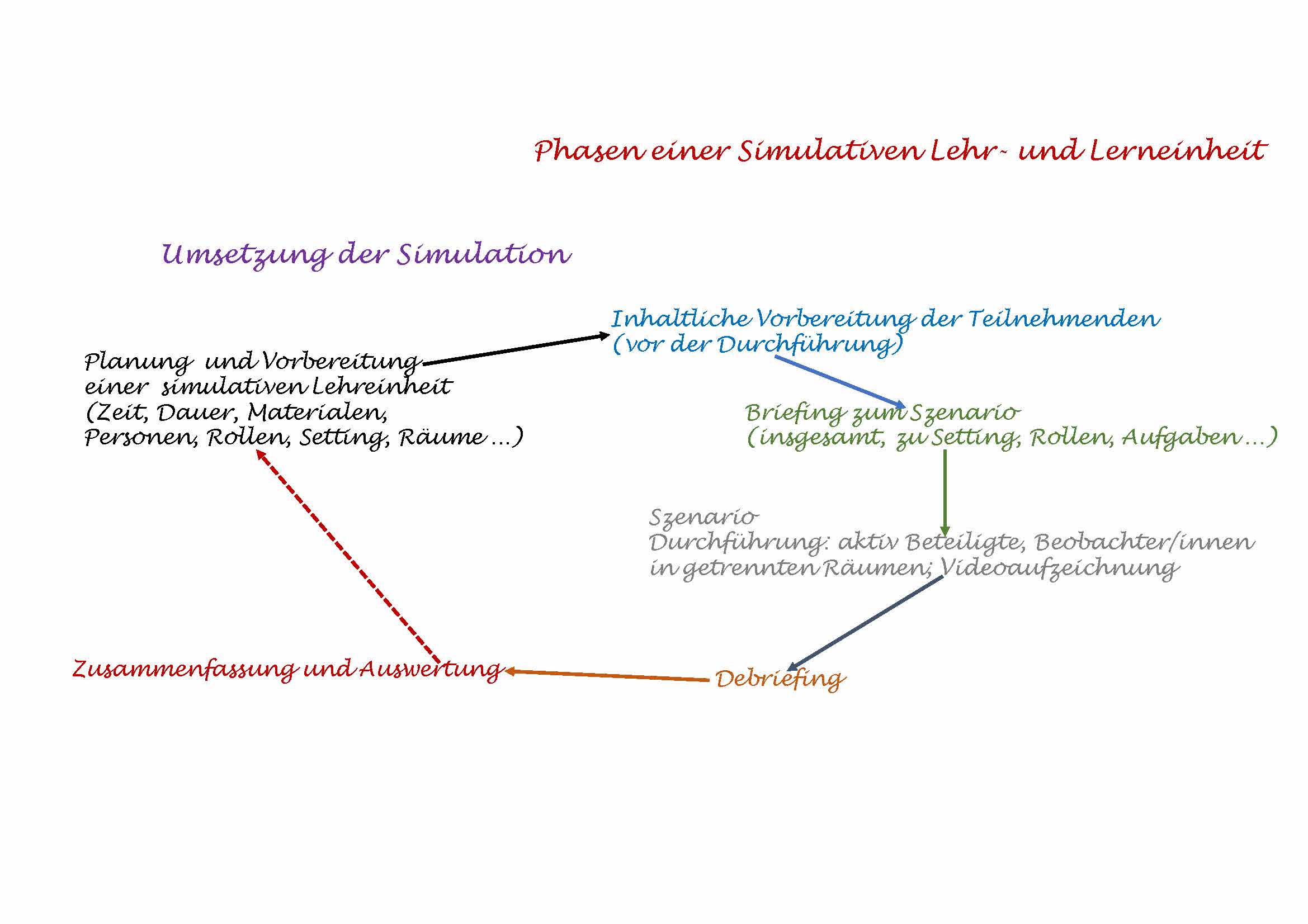
From the thematic framework of the respective module, content is defined that is to be applied by means of simulative work. These defined teaching and learning situations are worked out by the teachers according to the defined phases (briefing, implementation (scenario), debriefing) of simulative pedagogy:

Learning objectives (2-3 learning objectives, general and specific) are formulated for each learning unit. A „script“ is written for the selected action/situation/procedure in which the setting, the roles, the tasks of the actors and the observers (students of the seminar group) are characterised and developed in more or less detail. This description of the setting also contains developments and variations of behaviour, reactions and actions as measures that (can) occur if, for example, a situation develops away from the planned course of events or an event interferes with the situation (e.g. a complication).

The actors involved in the scenario are prepared according to their roles. Teachers act as instructors. This means that they plan the scenario, control the process and, if necessary, make modifications. During reflection, teachers take on a reserved, accompanying, enquiring, in-depth, moderating role.

The scenario is realised in a setting that reflects reality as closely as possible. This means that the room, people, actions, situations and processes are prepared according to the requirements. Situations are chosen from everyday professional life/context, the students take on roles associated with the situation and act in real time according to the learning objective formulated in advance.

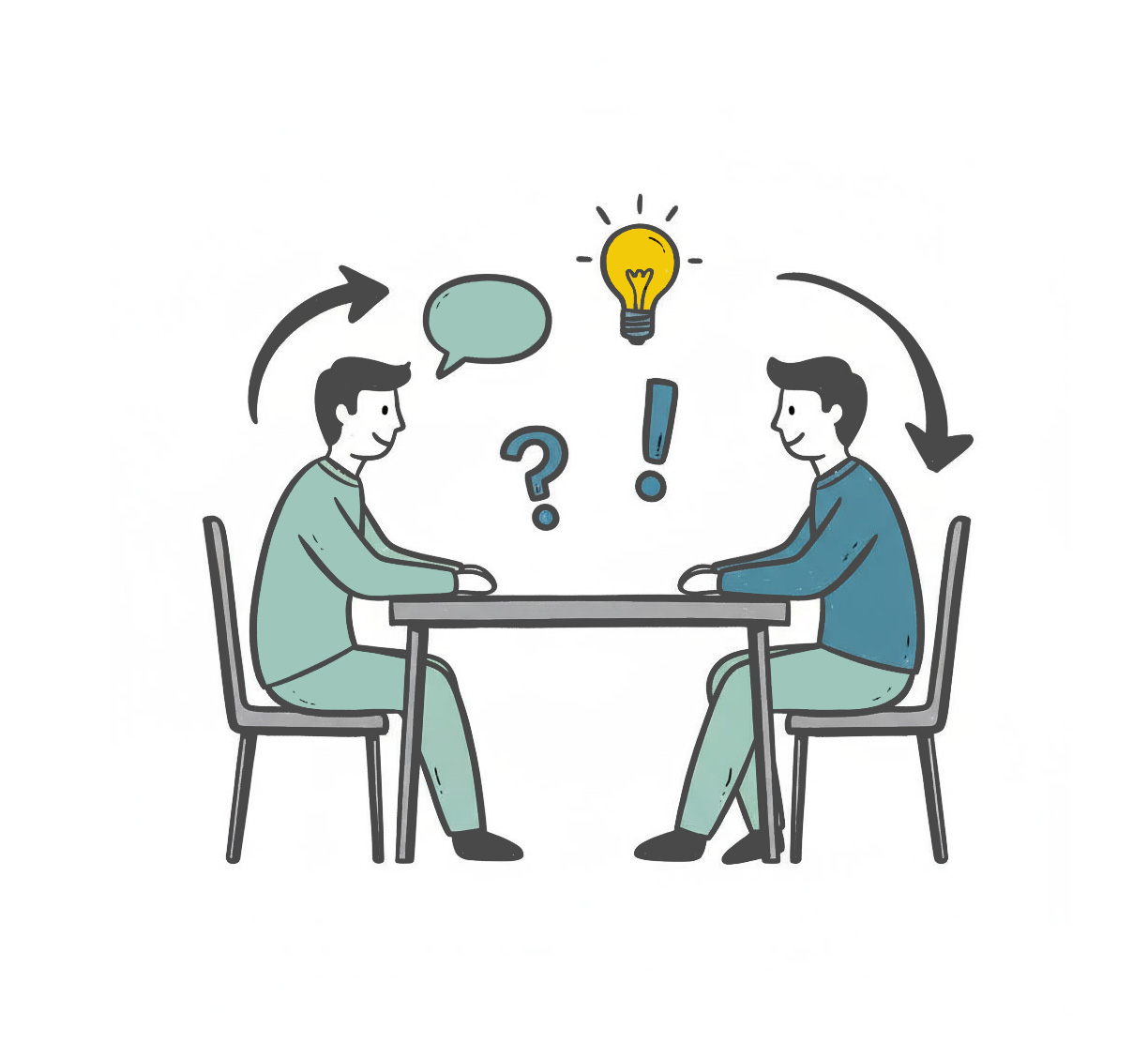
As part of the evaluation (debriefing), the participants then reflect on the situation, speech and actions with the other students, who follow the scenario via video in a live broadcast and contribute to the evaluation process using observation assignments. The debriefing is methodically structured. First, the actors describe the scenario using supporting questions. This is followed by an analysis with the aim of allowing the participants to reflect on and scrutinise their actions, their approach and their behaviour and come to conclusions. The debriefing does not contain any evaluation or feedback, but is aimed at reflection and self-reflection. Teachers are in the role of moderator.

This methodological approach does not correspond to a role play, because the setting and the realisation are implemented in a real, perceived situation and under realistic parameters. Participants regularly say that they are not in an exercise in the scenario, but in the actual situation. Simulative pedagogy makes it possible to incorporate the realism of these measures into the preparation of students for the demands of the labour market, teamwork, interdisciplinary cooperation and the joint development of solutions to practical problems through transfer and application in line with learning objectives.


Helpful links and sources

Your suggestion or question

We hope that the practical examples will be viewed critically, utilised and developed further and thus remain alive. Therefore, please use the comment function to give your assessment of this practical example. Share your experiences in the implementation or refer to similar didactic methods (please include references or links). 

Your assessment will first be checked by us and then approved.

Leave a Reply

Your email address will not be published. Required fields are marked *

Contact person for the teaching concept

Bild von Claudia Hoffmann

Claudia Hoffmann

Contact us

Selection of topics