Practical example

Interdisciplinary development of an analysis tool for educational portals to increase the practical relevance of history and computer science studies

Teachers
Prof Dr Anke John (History Didactics) and Prof Dr Marcel Spehr (Computer Science)
Last update
University(s)
Subject group(s)
Target group(s)
Format | Mode

|

In the project, students of applied computer science and history teaching are co-constructively developing an analysis tool for the empirical reconstruction of usage patterns on the edition and education portal evaschiffmann.de as well as an AI chatbot that expands the access options to the portal in a blended learning cooperation seminar. The analysis tool makes learning paths and usage behaviour in the digital learning environment visible (from overview data to detailed session histories) and is used in courses and school trials to strengthen practical relevance and data-based reflection.

 

The challenge of teaching

Prospective history teachers have rarely had the opportunity to systematically develop diagnostic skills and collect empirical usage data on learning behaviour in digital learning environments during their studies. At the same time, student teachers often lack technical access to reconstruct digital learning processes based on data - while computer science students need practical, educationally relevant use cases. In addition, little is known about how learners deal with digitally processed historical knowledge, historical sources and historical representations on educational portals.

Goals of your practical example

- Skills acquisition (history teacher training programme): Development of diagnostic and planning competences through data-supported reconstruction of learning paths and reflection on different usage/reading strategies in digital environments.
- Skills acquisition (computer science): Practice-orientated development and testing of an analysis tool (data analysis/web technologies) in a real application context of empirical teaching-learning research.
- Interdisciplinary co-construction: Promotion of interdisciplinary problem-solving and communication skills through joint concept and development work.
- Subject-specific didactic target perspective: Supporting a scientific and source-orientated approach to history in digital teaching and learning settings.

Prerequisites for implementation

- Time/organisation: Implementation as a cooperative teaching format over two consecutive semesters (development in the first, follow-up/reflection & data evaluation in the second), with block or cooperation sessions at both locations.
- Legal/data protection: Clarification of data protection requirements for the collection of (potentially personal) usage data and corresponding school consent/information processes.
- Infrastructure: Administrative access to the portal/backend and technical embedding of the tool in evaschiffmann.de.
- Tools/licences: Analysis environment (prototypically based on Matomo in the project) and any licences/components required for development and operation.
- Resources/personnel: Project support by teaching staff and project-related collaboration (work planning incl. conception, implementation, evaluation, dissemination).

Procedure

The implementation took place in a two-semester, digitally supported cooperation seminar between Applied Computer Science and History Teacher Training. At the beginning, organisational and legal framework conditions (in particular data protection and access rights to the portal) were clarified and the teaching/learning arrangements were planned in such a way that subject-specific work phases in both degree programmes could be interlinked with joint cooperation sessions.
In the first semester, the focus was on the co-constructive development of the analysis tool: the teacher training students developed analysis questions and usage scenarios for the evaschiffmann.de education portal from a didactic perspective, while the computer science students took on the technical implementation (based on Matomo prototypes, among other things) and gradually integrated the tool into the portal structure. At the same time, school-based data surveys were prepared and carried out: Learners used the portal in classroom situations or school-related settings, while the tool logged their interactions (learning paths, navigation, time spent on the site, etc.). These surveys served as an empirical basis and at the same time as a practical test in order to iteratively test and further develop the measurement logic, data quality and evaluation options.
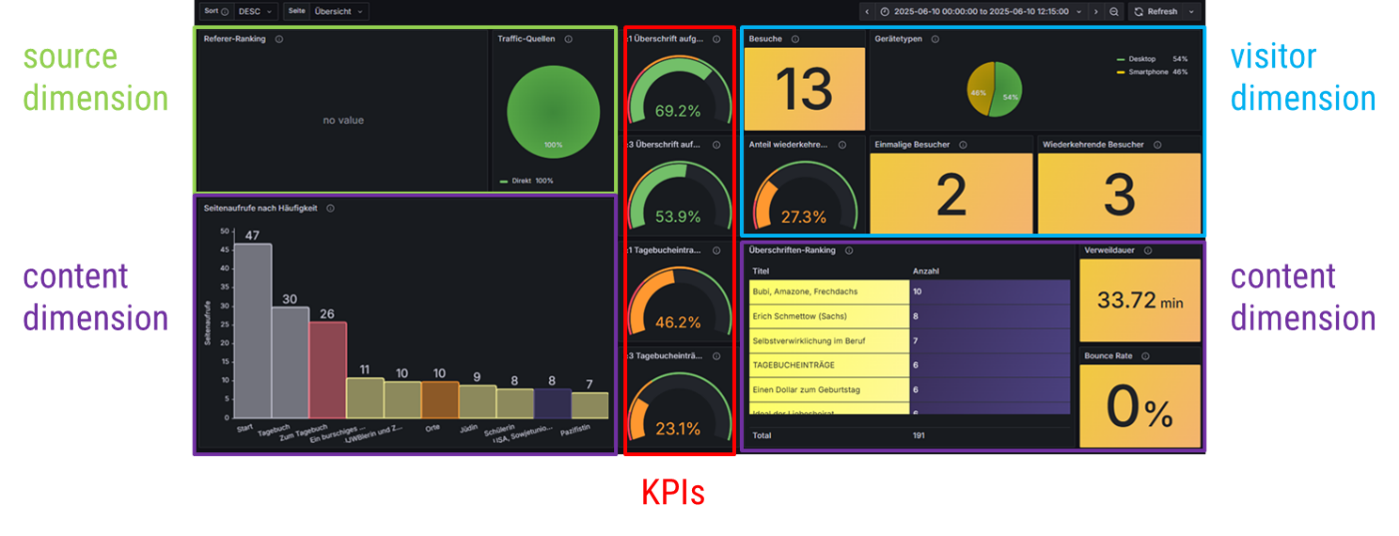
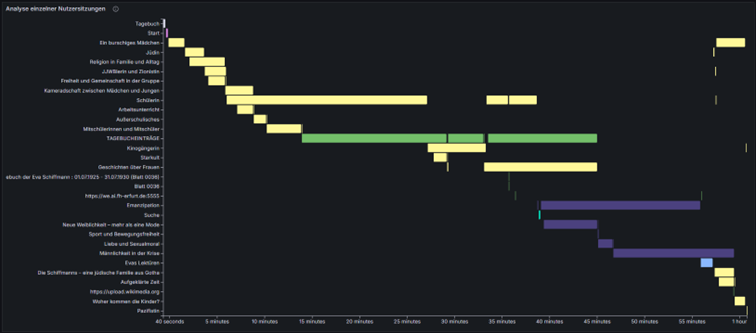
In the second semester, the focus was on analysing the usage data collected at school and the didactically reflected interpretation of the results. The students systematically analysed the data sets and linked the findings with didactic questions (e.g. typical navigation patterns, use of different materials, different reading strategies). The analysis was organised on two levels: On the one hand, overview data was brought together in a dashboard (e.g. access, recurring users, end devices, length of stay), while on the other hand, session histories were visualised in detail (chronological sequence of pages/elements visited) in order to be able to reconstruct specific learning paths. The tool was also further developed on the basis of the seminar reflections and the results of the analyses.

Material for the practical example

You can see a readme file created by students to describe the functions of the analysis tool as well as two prototype images of the two dashboard levels of the tool.

Dashboard level of the analysis tool_1
Dashboard level of the analysis tool_2
Readme file describing the analysis tool

Helpful links and sources

Your suggestion or question

We hope that the practical examples will be viewed critically, utilised and developed further and thus remain alive. Therefore, please use the comment function to give your assessment of this practical example. Share your experiences in the implementation or refer to similar didactic methods (please include references or links). 

Your assessment will first be checked by us and then approved.

Leave a Reply

Your email address will not be published. Required fields are marked *

Contact person for the teaching concept

Bild von Claudia Hoffmann

Claudia Hoffmann

Contact us

Selection of topics