
Practical example

Development of the online course „Logical argumentation“

Teachers
Matthias Rickes
Last update
University(s)
Subject group(s)
Target group(s)
Format | Mode

|

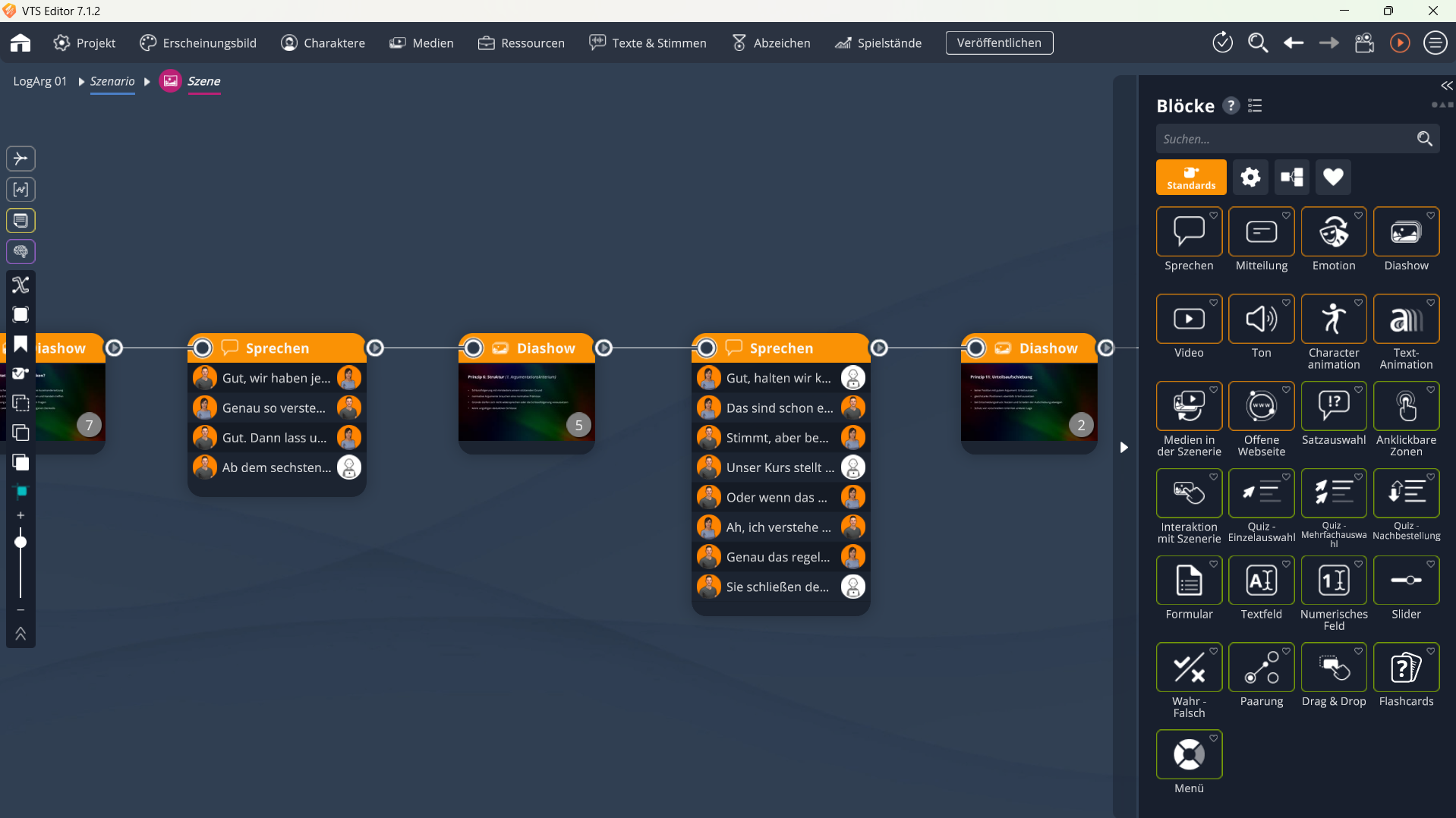
The completely new online course „Logical Argumentation“ is being developed at Schmalkalden University of Applied Sciences as part of a grant from the eTeach Network Thuringia. The course is aimed at students of all disciplines on Bachelor's degree programmes and teaches the basics of logical thinking and argumentative analysis. It will be offered for the first time in the winter semester of 2026/2027. The VTS Editor from Serius Factory, a professional authoring tool for interactive e-learning content, serves as the technical basis for the course development.


The challenge of teaching

Logical argumentation is a key skill that students need at the latest when writing term papers and theses - but also in everyday professional life when it comes to convincingly defending positions or asserting goals in discussions. At Schmalkalden University of Applied Sciences, there is currently no comparable programme that promotes this skill in a targeted and practical way.
Teaching this competence in a classroom format has its limits: role-playing and discussions, which are essential for practising argumentation skills, take up a lot of time - with the result that active participation is limited to a small number of students and most remain in the role of spectators. In addition, the subject matter of the course is very extensive, with around 60 different types of fallacies. Each of these logical traps requires several practice examples so that they can be reliably recognised and distinguished from good arguments. The number of exercises required therefore far exceeds what can realistically be covered in a classroom course.

Goals of your practical example

The online course „Logical Argumentation“ aims to systematically train students on all Bachelor's degree programmes in the ability to think and argue logically. The focus is on recognising fallacies and weak arguments - because those who can reliably identify fallacies also develop a good sense of what makes a good argument and are ultimately able to argue convincingly and logically consistently themselves. The course covers around 60 different types of fallacies and is based on the work „Attacking Faulty Reasoning“ by T. Edward Damer.
In order to achieve the density of exercises required to recognise each individual fallacy, the course relies on a very high number of authentic video examples that show real discussion situations and are directly linked to exercises. The course has a linear structure, but at the same time allows targeted access to individual modules for repetition or consolidation. It is designed both as an independent self-study programme and as an element that can be embedded in existing courses.

Prerequisites for implementation

No special technical requirements are necessary for students at Schmalkalden University of Applied Sciences, as the completed course is published on the university's own Moodle instance, which all students have access to anyway.
The reproduction of a comparable course by other teachers does not necessarily require the VTS Editor from Serius Factory. However, it offers the considerable advantage of integrating videos, audio, dialogue simulations and other interactive elements in a single authoring environment and linking them in an appealing, playful way.
It should be noted that the development of such a course involves considerable effort. As a complete replacement for a course with two semester hours per week, the course must cover a workload of approx. 30 hours for the students. The largest production effort is the creation of the video exercises: Between 250 and 350 short video scenes, each 10 to 30 seconds long, are planned, showing authentic discussion situations. This will be technically feasible through the targeted use of generative AI - specifically through the software dzine.ai and yapper.so, which enables the production of precisely specified dialogue videos.
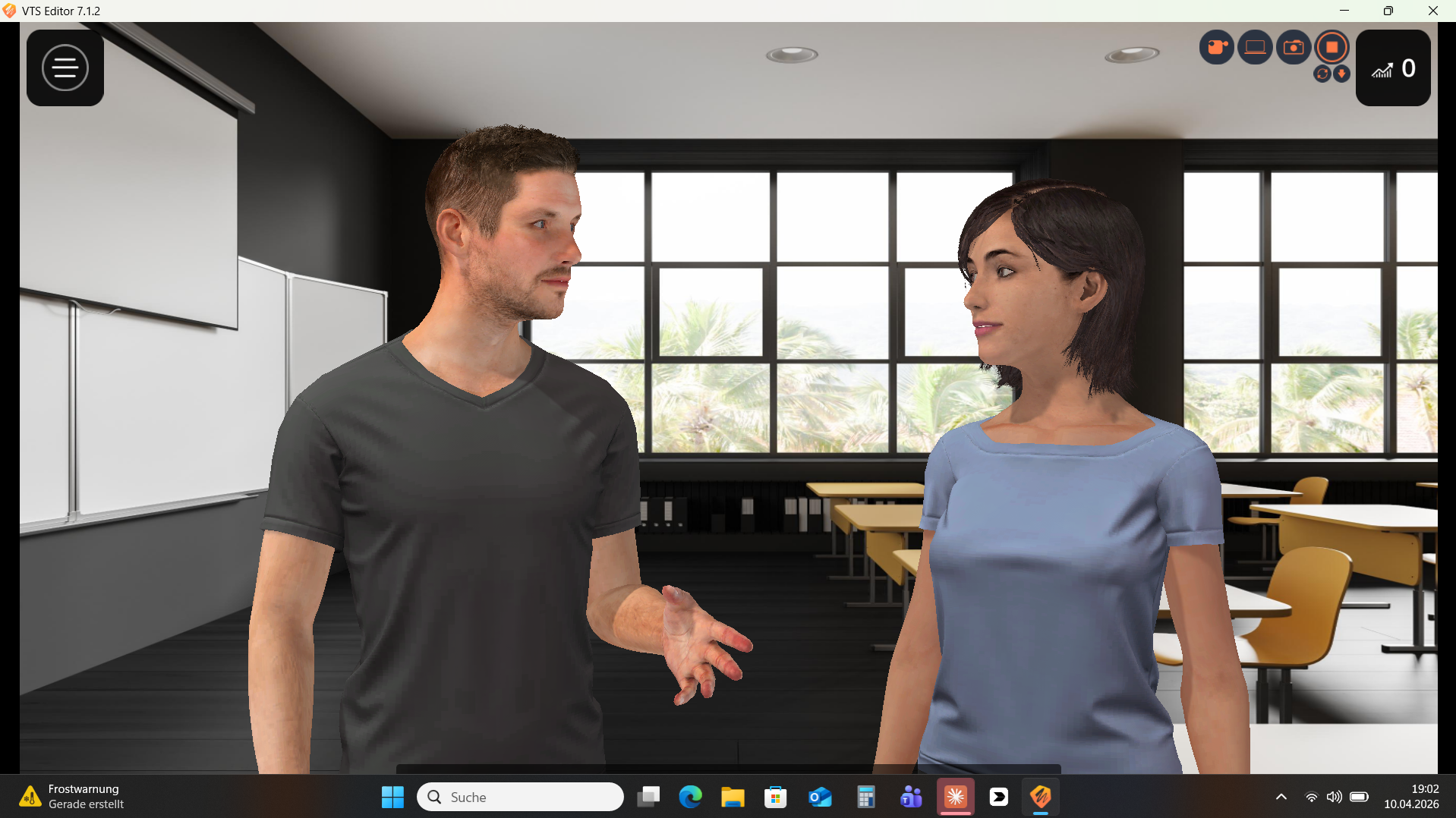
The theoretical course sections also require a considerable production effort: each learning unit is introduced by a short dialogue scene created directly in the VTS Editor and deepened by commented presentations with slides shown in parallel. Generative AI is also used for the efficient creation of the numerous slides. Claude for PowerPoint, for example, should be mentioned here.

Procedure

The course is developed entirely independently by a single instructor. The theoretical sections of the course and the practical video exercises are developed in parallel. Each learning unit is introduced by a short dialogue scene, which is created directly in the VTS Editor, and deepened by a commented presentation with slides shown in parallel. The video exercises are based on short, authentic dialogue scenes that are produced with the dzine.ai software and simulate real discussion situations. Each video exercise concludes directly with a task that trains students to recognise the respective fallacy.
The course is designed for complete self-study. Students complete it independently and at their own pace, without any accompanying classroom sessions. However, the lecturer is always available to answer questions in person. After its first use in the winter semester 2026/2027, the course will be continuously developed on the basis of personal feedback from students.

Your suggestion or question

We hope that the practical examples will be viewed critically, utilised and developed further and thus remain alive. Therefore, please use the comment function to give your assessment of this practical example. Share your experiences in the implementation or refer to similar didactic methods (please include references or links). 

Your assessment will first be checked by us and then approved.

Leave a Reply

Your email address will not be published. Required fields are marked *

Contact person for the teaching concept

Bild von Claudia Hoffmann

Claudia Hoffmann

Contact us

Selection of topics