Practical example

ICF! - Inclusion and Collaboration for the Future!

Teachers
Prof Dr Sandra Neumann (UE), Prof Dr Andreas Seibel (HSN)
Last update
University(s)
Subject group(s)
Target group(s)
Format | Mode

|

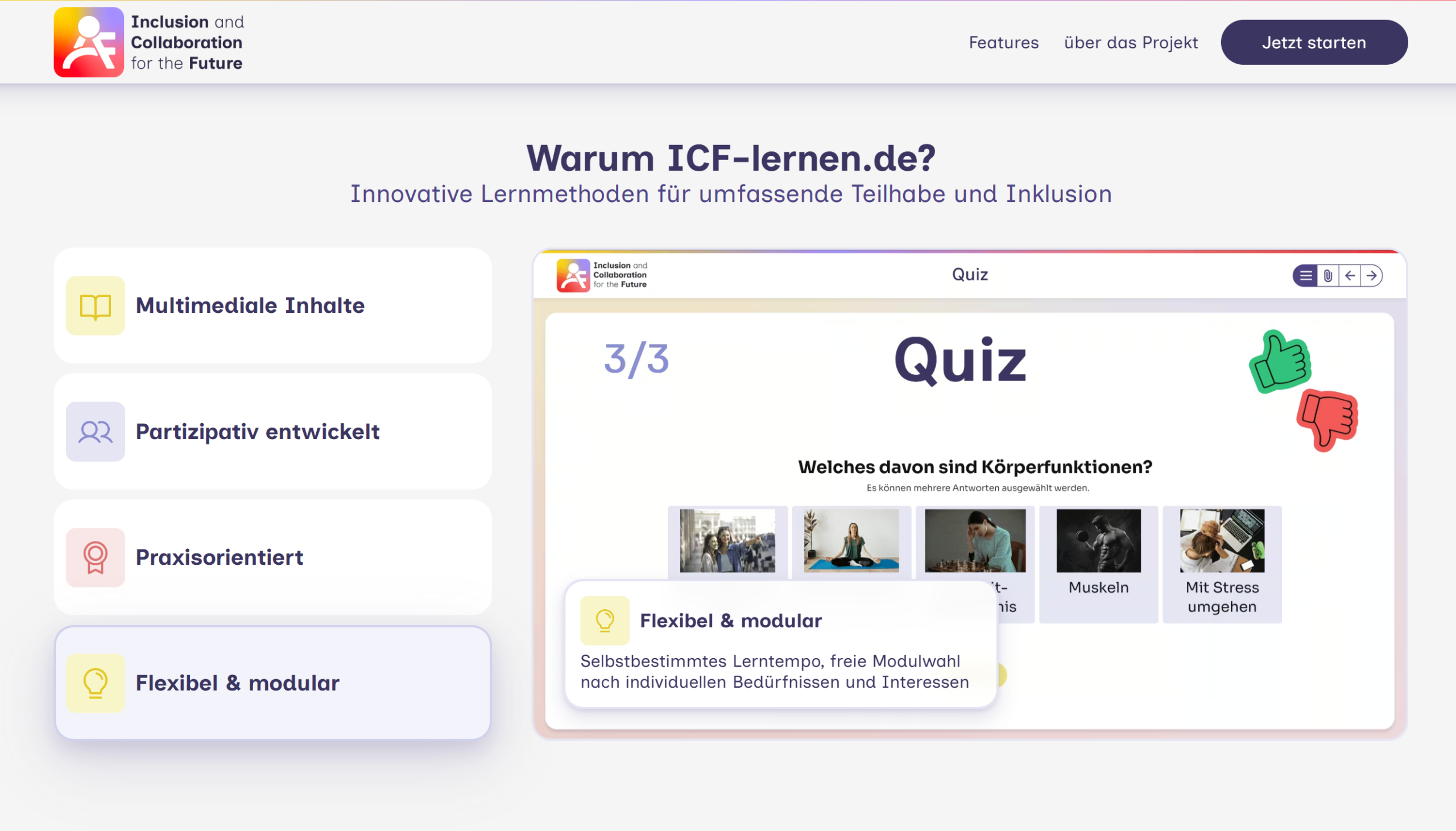
The aim of the project was to develop a practical, digital learning programme for the application of the International Classification of Functioning, Disability and Health (ICF). The idea behind ICF! was to create a multimedia, modular and competence-oriented self-learning concept that can be used in courses for educational and therapeutic degree programmes as part of blended learning. In a selectable module structure, the elements should guide students through flexible online phases of self-study. The focus is on authentic, participatory case presentations (people with health or participation impairments & relatives) with a concrete connection to their living environment. The aim is for students to acquire case-orientated knowledge and skills to establish routines for educational, social and therapeutic practice.
The modular structure of ICF! is designed to address different levels of knowledge: In transdisciplinary basic modules, basic knowledge of the ICF is taught using practical examples. In more in-depth advanced modules, practical professional skills for establishing relevant routines for counselling, diagnostics/needs assessment and help/support planning, including evaluation, are also to be acquired. Specific learning modules on various case studies focussing on needs assessment round off the programme.

The challenge of teaching

As a bio-psycho-social model, the International Classification of Functioning, Disability and Health (ICF; WHO, 2001) provides a standardised language for describing a person's functional state of health, disability, social impairment and relevant environmental factors.
The ICF is becoming increasingly important in German-speaking countries in the areas of rehabilitation, support planning, therapy and school. However, until 2026 there was no attractive multimodal, digital self-learning concept for its practical application in therapy and education. As a result, the ICF often remained at a theoretical level.

Goals of your practical example

The modular structure of the ICF! self-learning concept enables flexible integration, e.g. in internal training courses, qualification measures, self-learning programmes, training and further education or for sensitising specialists in different fields of work.
ICF! is available to all interested parties: 100% free of charge, practical, case-based, accessible, multimedia and as Open Educational Resources (OER) under CC BY-SA 4.0.

Prerequisites for implementation

The digital self-learning concept can be worked through by students or other interested parties at their own pace. A total of 7 longer interviews were conducted in the ICF! project, from which 59 videos were created for the learning modules. The self-learning concept itself comprises 5 basic modules, 4 advanced modules and 12 case study modules. All interactive modules were created using the Genially programme (https://genially.com/de/ ) and include quizzes for self-reflection. In addition, the greatest possible accessibility was ensured. This should ensure that the content is as comprehensible and accessible as possible.
The complete self-learning concept is available free of charge and freely accessible on the website https://icf-lernen.de to find. The videos created for the project are available on the ICF! youtube channel (https://www.youtube.com/@icfprojekt2025) are also available independently of the learning modules.

Procedure

The self-learning concept ICF! was designed in an interdisciplinary and participatory manner together with students from educational and health-related study programmes as well as people with disabilities and their relatives. The following cooperation partners could be won over, who enriched the project with their open-hearted and exciting interview contributions: Kai (@kairobinbosch), Amelie & Björn (@we_roll_the_world), Nikolaos & Sarah (@nikolaos.pegasos), Greta (@somehowdeaf), Christoph (@stottern_aufgeklaert) and Linn (@linusbade).
As a team with Miriam Grunwald (UE) and Chris Mertinat (HS Nordhausen), a modular, multimedia self-learning concept for practical work with the ICF (WHO, 2001) was developed with the Genially tool.

Material for the practical example

Your suggestion or question

We hope that the practical examples will be viewed critically, utilised and developed further and thus remain alive. Therefore, please use the comment function to give your assessment of this practical example. Share your experiences in the implementation or refer to similar didactic methods (please include references or links). 

Your assessment will first be checked by us and then approved.

Leave a Reply

Your email address will not be published. Required fields are marked *

Contact person for the teaching concept

Bild von Claudia Hoffmann

Claudia Hoffmann

Contact us

Selection of topics