Practical example

eLearning with Water: Between Landbased Learning and E-Portfolio

Teachers
Prof. Dr Caroline Rosenthal, Junior Prof. Dr Alexandra Toland, Claire Waffel, Andrin Albrecht
Last update
University(s)
Subject group(s)
Target group(s)
Format | Mode

|

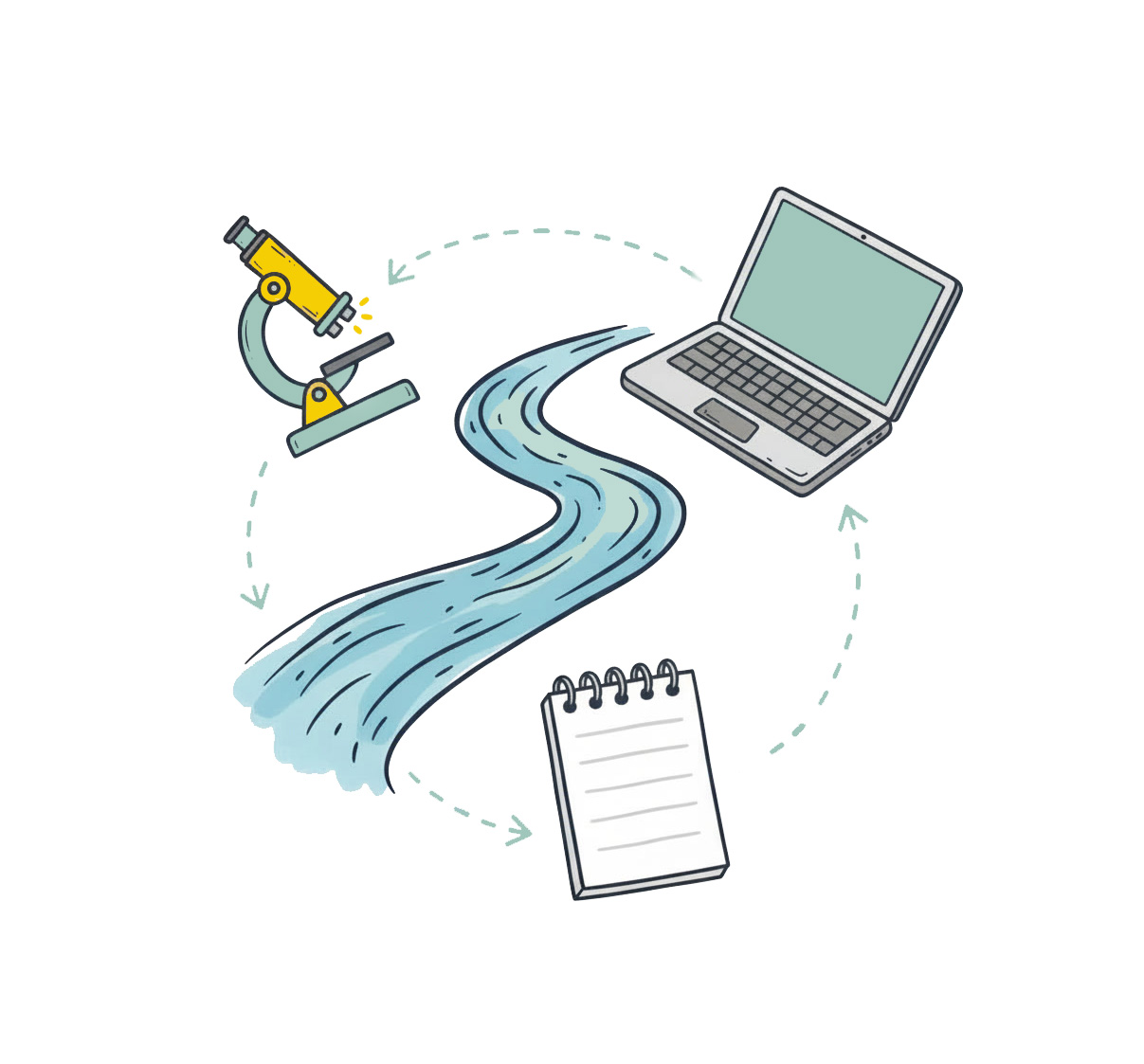
In the face of global water crises and dwindling freshwater resources, this project aims to reconsider the relationship between humans and water and to develop a new water consciousness that takes into account issues of ecological and social justice as well as symbolic and metaphorical aspects of water. These political and poetic dimensions of water were explored using analytical, empirical and theoretical methods that integrate artistic, intuitive and multimedia approaches. By following the current of Blue Humanities - an emerging field of research concerned with the cultural, historical, philosophical and artistic dimensions of water and aquatic environments - the project seeks to blur the boundaries between different academic, institutional and epistemological fields.

In a blended learning format, the project combines water-related on-site learning phases in a „green classroom“ with online teaching. During the on-site sessions, we explore the rivers Ilm and Saale through sensory walks, hydromorphological investigations with the support of experts from the natural sciences and guided creative writing tasks. These experiences are framed and deepened by several close reading sessions of theoretical texts about water in and outside of literature. This format allows students to meet for the outdoor presence sessions and remain at their home universities for the remainder of the seminar. To receive credit for the course, they must submit e-portfolios at the end of the semester consisting of a scholarly essay on a self-selected water topic as well as various creative responses to what they have learned about and from water. The students' creative work will be collected in a digital publication.

The challenge of teaching

The challenges of this project lie less in the teaching than in the final graphic realisation: in the consolidation of the creative contributions in an e-portfolio and the subsequent publication via „Digitale Bibliothek Thüringen“. This requires close cooperation with a graphic design specialist over a longer period of time, including several revision rounds and clear communication with the students from the outset as to the form in which publication material must be submitted and which changes may be made to it for aesthetic consolidation. Ideally, one of the seminar leaders should have sufficient design knowledge to be able to design the portfolio from a position familiar with the seminar content.

Goals of your practical example

The aim of the project is to bring together students at Bachelor's and Master's level from the arts, design and humanities in an interdisciplinary learning format in order to develop new perspectives on human-water relationships. Based on Blue Humanities approaches, the ecological, cultural, political and aesthetic dimensions of water will be analysed together. This involves analysing texts and theoretical concepts as well as developing a reflected perception of water as an ecological, social and symbolic actor. A further aim is to combine scientific analysis with artistic and creative practice and to encourage students to try out their own forms of knowledge production. Through this combination of analytical, empirical and sensual-creative methods, a greater awareness of issues of environmental justice, scarcity of resources and sustainable human-environment relationships is to be created and published online in a form that is also tangible for outsiders.

Prerequisites for implementation

Several organisational and institutional prerequisites are necessary for the implementation of such a teaching format. These include, in particular, interdisciplinary collaboration between different subject areas (literature, design, natural sciences) as well as joint course planning and coordination by several lecturers. It is also important to combine digital infrastructure - such as learning platforms for materials, communication and e-portfolio submissions - with face-to-face formats outside the seminar room. Suitable locations for excursions and the opportunity to carry out practical exercises on site also play a key role. In addition, the involvement of external experts, for example from the environmental or natural sciences, is helpful in order to open up different perspectives on water. Finally, the format requires sufficient flexibility in terms of time to allow for both analytical discussions and creative work processes by the students.

Procedure

The seminar is designed as a blended learning format and combines digital teaching formats with practice-orientated face-to-face events. Key theoretical and literary texts on water, climate and the environment from the field of Blue Humanities are read and discussed together in online sessions. This is complemented by several excursions to rivers, where students explore water landscapes through sensory walks, ecological observations and hydromorphological studies. These experiences are deepened through creative writing and perception exercises as well as discussions with experts from the environmental sciences. In individual online consultations, the teachers accompany the development of their own projects. Finally, the students document their results in an e-portfolio, which includes a scientific essay on a self-chosen water topic as well as creative and artistic contributions.

Your suggestion or question

We hope that the practical examples will be viewed critically, utilised and developed further and thus remain alive. Therefore, please use the comment function to give your assessment of this practical example. Share your experiences in the implementation or refer to similar didactic methods (please include references or links). 

Your assessment will first be checked by us and then approved.

Leave a Reply

Your email address will not be published. Required fields are marked *

Contact person for the teaching concept

Bild von Claudia Hoffmann

Claudia Hoffmann

Contact us

Selection of topics