
Practical example

Interdisciplinary innovation in energy research - further development of a module into a cross-university course

Teachers
Univ.-Prof. Dr.-Ing. Dirk Westermann
Last update
University(s)
Subject group(s)
Target group(s)
Format | Mode

|

In the project „Interdisciplinary innovation in energy research - further development of a module into a cross-university course“, the course Energy Research and Innovation Methods 2 at TU Ilmenau was to be further developed into a cross-university course. This practical example describes what needs to be considered during the further development.


The challenge of teaching

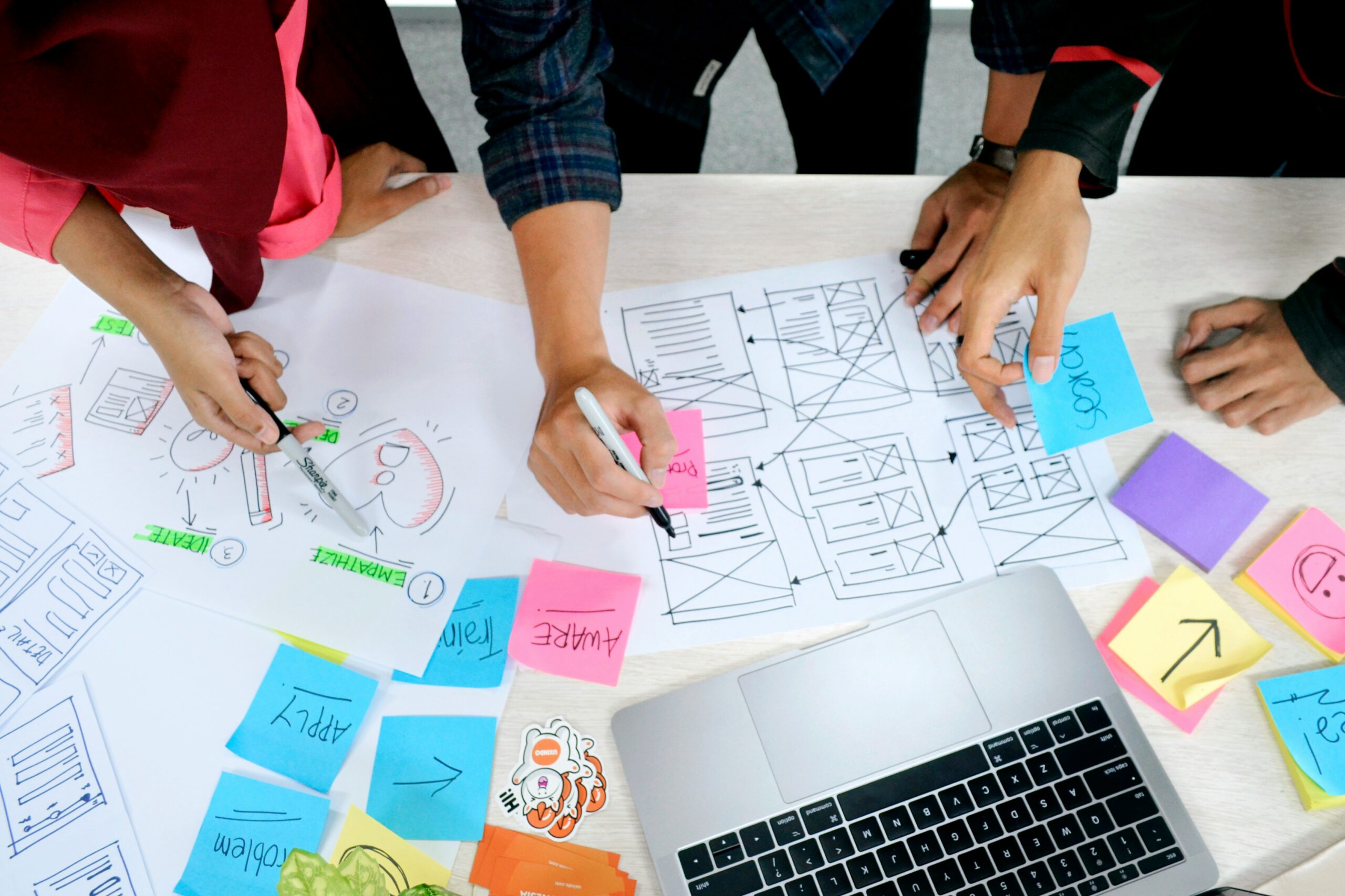
Graduates of technical degree programmes, in particular the Master's degree programme in Electrical Energy Systems, require a High degree of interdisciplinarity, to be able to adequately meet the complex challenges of the energy transition. The degree programme is specifically geared towards an industrial career with grid operators and an academic career. However, traditional engineering curricula do not usually provide for corresponding interdisciplinary teaching formats. For this reason, the modules Energy Research and Innovation Methods 1 and 2 are integrated into the curriculum of the Master's degree programme in Electrical Energy Systems. In these modules, students Innovation methods mediated, in particular Scrum and design thinking. Their application is tested on the basis of practical challenges.

By opening up the module to other degree programmes and students from other universities, interdisciplinarity is specifically increased. In this way, questions can be more closely aligned with real innovation and development processes and worked on in competing design teams. This enables a realistic simulation of cooperative and at the same time competitive forms of work that are common in industrial innovation contexts.

Due to the physical distance between the participating partner universities, the realisation of the teaching format requires a Hybrid teaching and learning environment which enables students to work together across locations and supports both synchronous and asynchronous forms of work.

Goals of your practical example

The further development of the course „Energy Research and Innovation Methods 2“ into a hybrid, cross-university teaching format programme aims to systematically strengthen the interdisciplinary skills of students. Through the targeted integration of other disciplines in addition to electrical engineering and energy systems engineering, the breadth of content of the module increased and at the same time the Improved accessibility for students from different degree programmes. In this way, a learning environment is created in which interdisciplinary perspectives can be integrated and co-operative forms of work can be tried out.

The implementation of these measures serves to prepare students specifically for the demands of the labour market, in which teamwork, interdisciplinary cooperation and the ability to jointly develop solutions play a central role.

Prerequisites for implementation

For the implementation, a Stable and reliable university partnership is seen as a fundamental prerequisite. Both partner institutions must be in a position to Sufficient number of students for participation. In recent years, a number of participants of around eight to ten students has proven to be suitable for using the design thinking method. With this group size, two teams can be formed to work on a joint design challenge in parallel and in a deliberately competitive setting. This supports both collaborative and competitive learning processes.

In addition to organisational requirements, the following must also be Suitable technical framework conditions be created. The teaching room should be equipped in such a way that two teams can participate in separate online meetings at the same time and at the same time have the option of holding joint meetings with a remotely connected group. This requires two video conferencing systems as well as suitable infrastructure for capturing, visualising and sharing notes. This can be realised, for example, through the use of tablets that can also be used for regular teaching.

If students use their own devices, a sufficient supply of power sockets and a stable internet connection must be guaranteed. For online meetings in particular, a connection via LAN sockets is recommended to ensure sufficient bandwidth at all times.

Procedure

Within the scope of the project, the technical prerequisites for the realisation of a hybrid course have been created. To this end, existing equipment will be specifically updated by purchasing smartboards and tablets and upgrading the video and audio system. The room will also be equipped with flexible furniture to support different teaching and working situations.

The installed technology is then trialled and systematically evaluated as part of regular lectures and tutorials. Individual optimisations will be made on the basis of this trial phase, in particular by setting up LAN connections for conference laptops to ensure stable online connections. Once these adjustments have been completed, the hybrid course will be planned in detail and students will be informed about the process, requirements and working methods at an early stage.

During the implementation, a Compact input day for the students realised. In the subsequent Retrospective shows, however, that the applied design thinking method too complex for a one-day format is. It is considered more expedient to Structure with several project days in each of which one methodological module is dealt with in depth. The final event is also organised in hybrid form. It turns out that a physical first meeting for teamwork of the participants is advantageous in order to support familiarisation, group formation and confidence building.

A central condition for success is also the Continuous support from an experienced design thinking coach who moderates and methodically supports the process throughout its entire duration. If further contacts are required, appropriate mediation can take place.

Material for the practical example

A paper was written as part of the eTeach project and presented at the STEM Symposium 2025 at Nuremberg Institute of Technology. This paper sheds light on the Energy Research and Innovation Methods 2 course, which was further developed as part of the project:
C. T. Gatermann, N. I. Belz, R. Pabst and D. Westermann, „Curriculum Design for a Research-Oriented Energy Systems Master,“ 6th Symposium on University Teaching in STEM Subjects, Nuremberg, Germany, 2025, pp. 161-169, doi: https://doi.org/10.57825/repo_in-6369

Helpful links and sources

Your suggestion or question

We hope that the practical examples will be viewed critically, utilised and developed further and thus remain alive. Therefore, please use the comment function to give your assessment of this practical example. Share your experiences in the implementation or refer to similar didactic methods (please include references or links). 

Your assessment will first be checked by us and then approved.

Leave a Reply

Your email address will not be published. Required fields are marked *

Contact person for the teaching concept

Bild von Claudia Hoffmann

Claudia Hoffmann

Contact us

Selection of topics