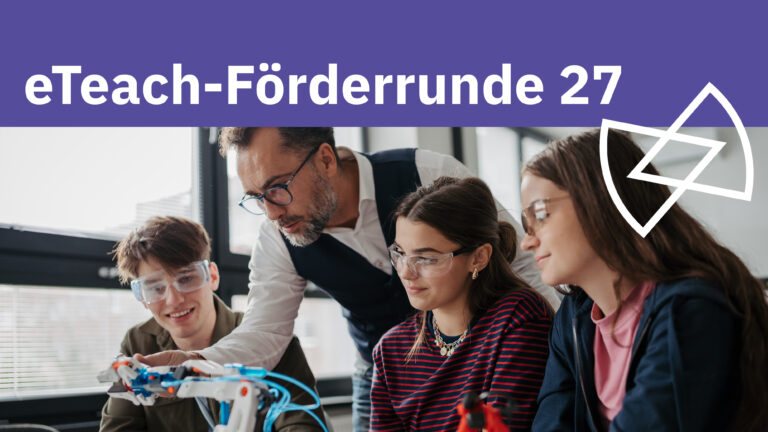

The 2027 eTeach Grant Program Focuses on Future Skills and AI
In 2027, the eTeach Network Thuringia is funding a total of eight innovative teaching initiatives: Three Cooperative Initiative Projects and five eTeach Freedom Projects were selected as part of this year’s call for proposals. With 25 applications for Cooperative Initiative Projects and 19 applications for eTeach Freedom Projects, the call for proposals once again generated significant interest. A total of 44 proposals that demonstrate how dedicated Thuringian faculty members are to advancing higher education.
This year's funding initiative focused on the question of how Future skills can be specifically promoted in higher education. In particular, there was significant interest in the connection between future skills and artificial intelligence. Numerous projects focus on AI-supported teaching and learning scenarios, the use of generative AI, and the question of how students can develop a reflective and responsible approach to AI.
Cooperative Initiative Projects 2027
The Collaborative Initiative Projects bring together faculty members from various universities in Thuringia to develop and test innovative teaching concepts and to examine their transferability.
AI-Supported Practical Simulation for Applied Quantitative Problem Solving (PraxisSim)
Friedrich Schiller University & Ilmenau University of Technology
In the project led by Dr. Celso Gustavo Stall Sikora and Prof. Dr. Volker Nissen, a web-based AI simulation is being developed in which students tackle realistic project scenarios involving unclear, fragmented, and sometimes contradictory information. With the help of AI personas, students learn to independently identify problems, gather specific information, synthesize different perspectives, and develop appropriate solutions.
Play-Based Skill Development in Immersive Learning Environments on the Behavior of Structural Systems Under Seismic Loads (SKILLS)
Bauhaus University Weimar & Technical University of Ilmenau
Together with students, Assistant Professor Lars Abrahamczyk, Ph.D. (Eng.), and Gunther Kreuzberger, M.S. in Computer Science, are developing an immersive educational escape room that examines the behavior of structural systems under seismic loads, such as during earthquakes. The XR application makes it possible to safely and repeatedly experience damage scenarios that are otherwise difficult to access in real life.
The Open AI Exam: Developing and Testing a Competency-Based Exam Format in the Age of Generative AI
Friedrich Schiller University & Bauhaus University Weimar
A team led by Prof. Dr. Michael Wessel and Dr.-Ing. Andrea Lück is further developing the open-book exam into an open-AI exam. Students are permitted to use generative AI, but the problems cannot be solved simply by using prompts. Rather, students are required to evaluate AI outputs from a subject-matter perspective, assess them critically, and use that assessment to make independent and well-reasoned decisions. To this end, new question types, a grading rubric, and an AI assessment system—which runs on the university’s own servers—are being developed.
>>> Click here to go to the main page for the Cooperative Impulse Projects
eTeach Open Space Projects 2027
The eTeach open spaces enable instructors to further develop their courses in a targeted manner and to experiment with new teaching methods and digital tools. The five selected projects rely on automated feedback, interactive preparation, game-based learning, and digital simulations to support students in independently and actively acquiring skills.
FLiP – Feedback-Based Learning in Programming Education
Gera-Eisenach Cooperative State University – Prof. Dr. Thomas Heinze
The project advances the pedagogy of programming education by automatically evaluating programming exercises and providing students with immediate feedback on their solutions. This timely feedback is intended to support the learning process, highlight errors early on, and guide students as they gradually build their programming skills.
From Procrastination to a Self-Directed Learning Routine—Tutorial Support in Digital Teaching Formats
Schmalkalden University of Applied Sciences – Prof. Dr. Kurt Englmeier
The project strengthens tutorial support in existing digital learning formats offered by the Department of Computer Science. To this end, interaction patterns are being developed and integrated into digital learning processes to counteract procrastination. The goal is to provide students with more targeted guidance, encourage their active participation, and support them in developing self-directed and consistent learning routines.
Engaging Digital Preparation for Experimental Courses in Mechanical Process Engineering
Ernst Abbe University of Applied Sciences, Jena – Prof. Dr. Paul Engelke
Six digital preparatory modules are being developed for selected, thematically related lab experiments. Interactive elements encourage students to familiarize themselves with the operating principles and experimental setup before the in-person session and to formulate hypotheses about the system’s behavior. This is intended to help them start the experimental courses better prepared and enable them to interpret their observations and experimental results more effectively.
„Play the Factory“ – A Gamified Learning Environment for Industry 4.0 and Industry 5.0 Skills
Schmalkalden University of Applied Sciences – Prof. Dr. Florian Johannsen
„Play the Factory“ creates a gamified learning environment in which students can independently carry out Industry 4.0 scenarios in small groups using existing machine components. Simulation components bring theoretical concepts to life in a playful way. The project thus combines action-oriented learning with an exploration of modern industrial technologies and their potential applications.
Wokwi-Gym – An Interactive Simulation Environment for Embedded and Mechatronic Systems
Schmalkalden University of Applied Sciences – Prof. Dr.-Ing. Christoph Menz
The project is developing an easily accessible simulation environment that allows students to independently examine and modify technical systems and observe the effects of their interventions. To this end, modular simulation components are being developed that build upon one another. They enable step-by-step, hands-on learning and help students better understand technical concepts through their own experimentation.
>>> Click here to go to the main page for the eTeach Freiraum projects
Outlook
The projects funded in 2027 demonstrate the wide variety of approaches being taken to further develop higher education in Thuringia. From AI-supported simulations and new exam formats to immersive learning environments, interactive programming exercises, and gamified technical learning environments, a variety of approaches are emerging to more actively engage students in the learning process and prepare them for complex professional challenges.
The connection between subject-specific learning and cross-disciplinary competencies is particularly evident here: Students should be able to identify problems independently, critically evaluate information, develop solutions collaboratively, and use digital tools thoughtfully. In this way, the projects address the “Future Skills” focus area and demonstrate how these competencies can be fostered in specific teaching and testing situations.
This creates momentum for a forward-looking approach to higher education that makes pedagogically sound use of digital opportunities and prepares students for a changing world of work and life.