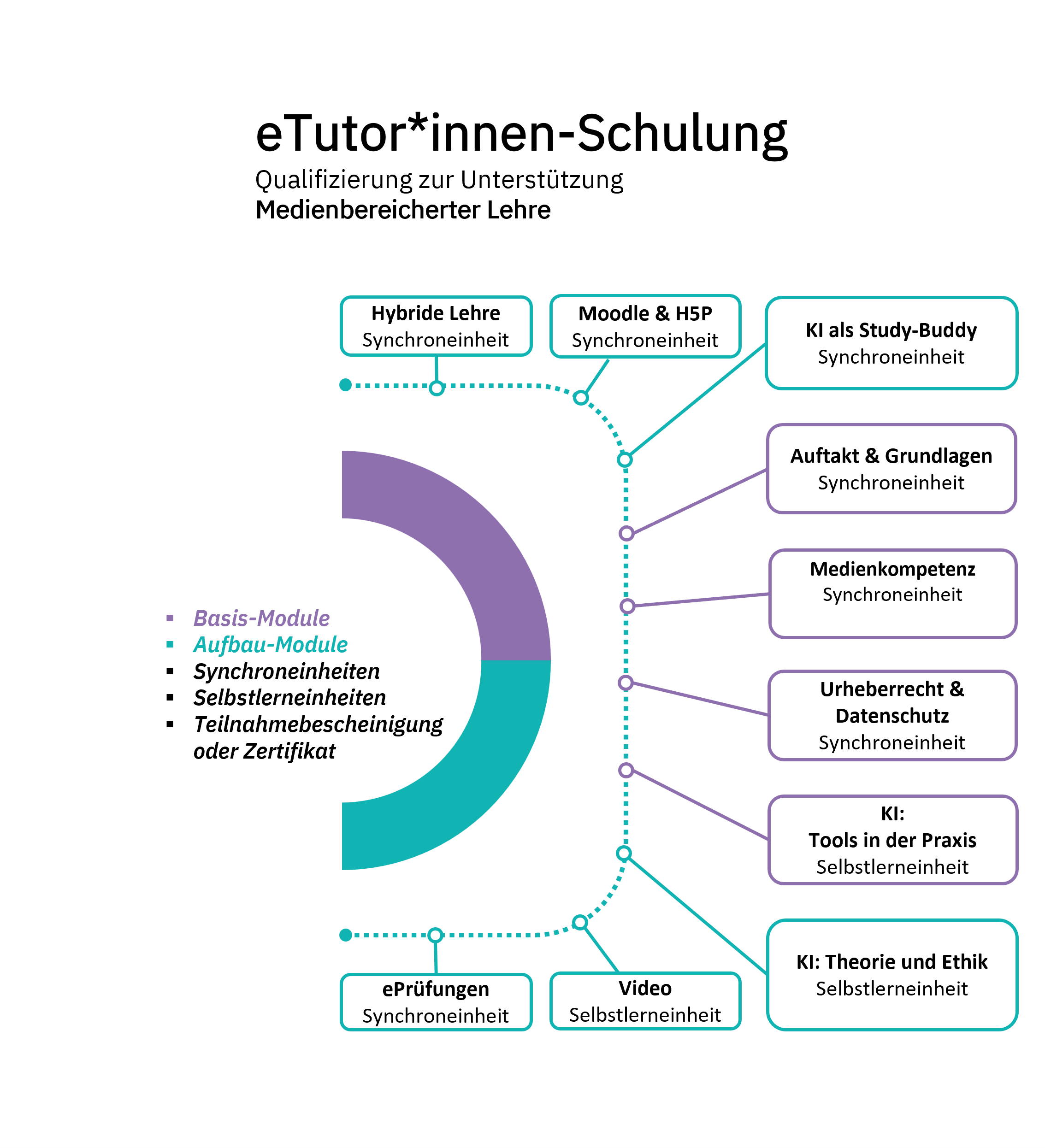
eTutor training
Are you a student and interested in media-enhanced teaching and learning?
Then you've come to the right place!
In our free eTutor training, you can learn more about topics such as media didactics and digital learning environments in hybrid- and online-workshops and Moodle self-study rooms.
Here You can sign up!
Contact person for this topic:
What are eTutors?
These are students who specifically support lecturers in using digital forms of teaching and learning and integrating digital tools into their teaching. In addition, eTutors also advise and support other students.
What will you learn in the eTutor training?
- Formats of media-enriched teaching and matching methods
- Use and design of multimedia learning resources
- Use of digital tools (especially video, AI tools, Moodle learning management system)
- Digital exam formats
- Dealing with copyright and data protection in teaching
How can you take part in the eTutor training?
You can complete the entire training program or participate in individual modules. You are free to choose how you would like to approach the modules. You can work through the individual modules in the self-study rooms or participate in the respective module workshop (online).
What are the benefits of the eTutor training?
- You will expand your knowledge in the field of media-enriched teaching and increase your media skills.
- You will receive a participation confirmation or a certificate that will look good on your CV.
Modules
The kickoff event marks the start of the new round of eTutor training offered by the eTeach Network Thuringia. Before we really dive into the content, we’ll take some time to get everyone settled in together.
First, we’ll go over the organizational details. You’ll learn how the training is structured, what dates are coming up, and what we expect from you. After that, you’ll get to know each other. We’d also like to know what brought you to this training and what you hope to gain from it. Your answers will help us tailor the next few weeks to your interests.
In the second part, we'll introduce the tools that will guide you through the training. These include VCT, BigBlueButton, and Congeno. Finally, we'll present the courses you can choose from.
We look forward to seeing you!
Click here to go to the Registration!
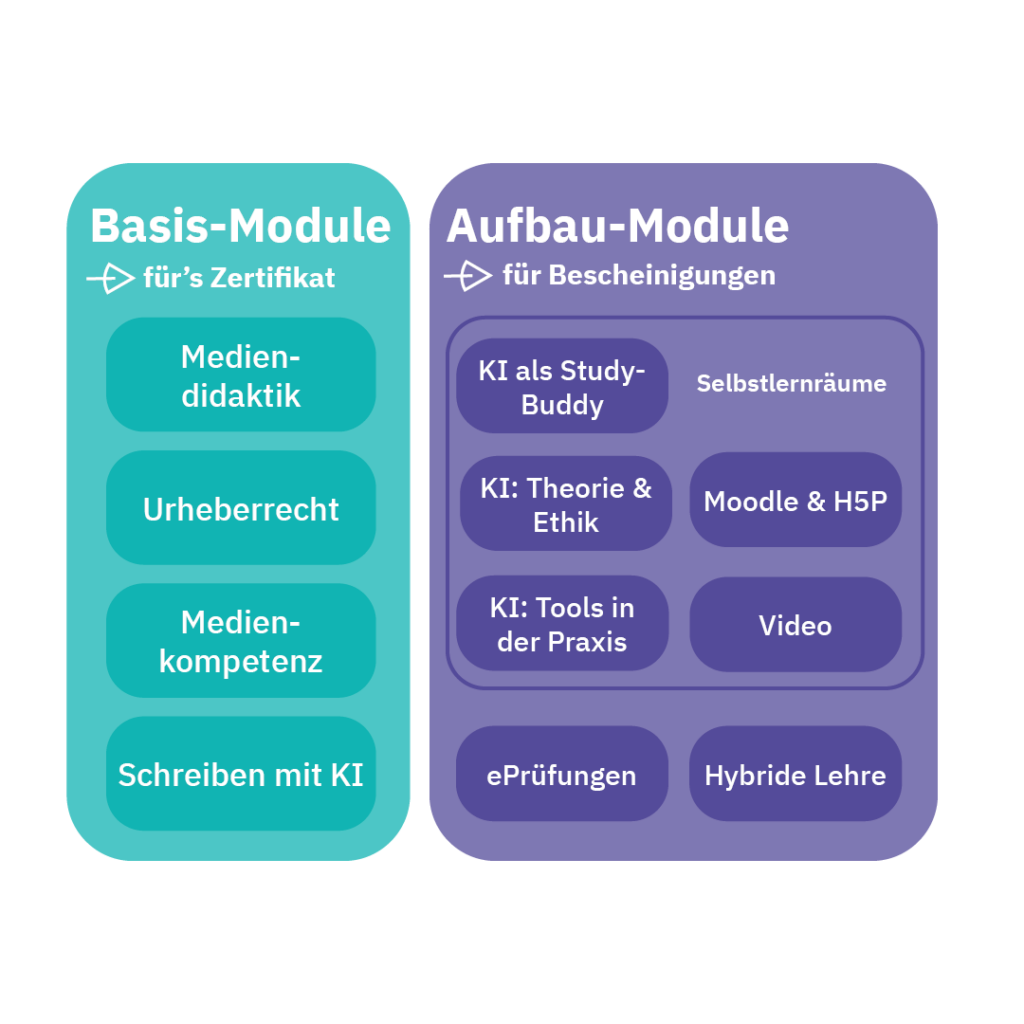
To provide educators with the best possible support in preparation and implementation, participants in this course will learn the basics of planning and creating educational videos, covering preparation, filming, and post-production. Topics covered include the use of shooting schedules and storyboards in the planning phase, various video formats, as well as media-pedagogical and technical aspects of filming and editing. Upon completion, the e-tutors will have gained initial experience in planning, production, and post-production.
Click here to go to the Registration!


You will learn the basics of the learning management system Moodle and H5P so that you can provide lecturers with the best possible support for technical implementation in the future.
Learning objective: You will learn the basics of how to create your own Moodle course step by step and get an overview of the various functions and design options.
Click here to go to the Registration!

You will learn not only about the possible applications of AI in higher education, but also about the challenges it presents. After completing the module, you will be able to integrate AI sustainably and reflectively into your everyday studies and generate teaching content. You will be introduced to the topics of prompting, seeding and the generation of teaching and learning content, and you will also critically question the application and ethical background of AI in higher education.
Click here to go to the Registration!
In this module, you can try out various AI tools in practice. Together, we will explore text, image and generating tools and explore their functionality and possibilities.
Click here to go to the Registration!

How can artificial intelligence help with exam preparation? In this workshop, students (and interested teachers) will learn how they can use ChatGPT as a digital learning buddy via role prompts - e.g. as an explanation aid, exam coach or quiz master. By assigning specific roles to the AI, new conversational situations are created that support individual learning. Together, we will try out various application scenarios and also reflect on the limits of AI-supported learning assistance.
Click here to go to the Registration!

In this course, e-tutors explore the legal framework governing the use of copyrighted works in courses and learning materials. They learn to distinguish between different types of works and to assess the extent to which these may be used in higher education. In addition, the course covers open content and open educational resources as alternatives to copyrighted materials, as well as the basics of data protection.
Click here to go to the Registration!

This course serves as the foundation of the training program and provides a theoretical introduction to the fundamentals of planning media-enriched higher education instruction, enabling participants to evaluate and implement specific practical scenarios. Through their participation, the eTutors will become familiar with basic teaching formats and concepts for developing didactic frameworks. Afterward, they will be able to describe the impact of media when used in higher education and explain the opportunities and challenges associated with its use. In addition, they will be able to identify the contextual factors that significantly influence planning and explain how these should be taken into account.
Click here to go to the Registration!

In this course, participants will learn about the fundamental characteristics of hybrid higher education in order to best support instructors in implementing it.
Upon completion of the course, the e-tutors will understand what is meant by ‚hybrid teaching‘ and will be familiar with various concepts. They will reflect on their own experiences with hybrid teaching and learning settings and understand the advantages and disadvantages of hybrid teaching in the context of in-person and online instruction. Participants are familiar with various technical setups for implementing hybrid teaching, are aware of technical requirements and possibilities, and have learned about specific implementation examples at universities in Thuringia. They know and understand the methodological and pedagogical challenges of hybrid teaching and, in particular, are aware of ways to promote interaction and engagement. In addition, they are familiar with data protection issues in the context of hybrid teaching and learning settings and are able to reflect on them.
Click here to go to the Registration!

The course is designed for participants who already work with digital media on a daily basis but have rarely taken the time to systematically reflect on these experiences or place them in a broader context.
At the outset, participants clarify their own understanding of media literacy and assess their own skills. They then learn about the development and dimensions of the concept of media literacy and examine examples of how the media landscape has changed since the mid-1990s due to the development of social media and the rapid expansion of digital tools in higher education. In the final section, they are introduced to the European DigComp Framework, a current reference framework for digital competencies. The e-tutors receive an overview of the framework’s structure and competency areas, address typical challenges and points of criticism, and are ultimately able to reflect on their own profile of digital and media competencies.
Click here to go to the Registration!

We have always written with the help of media, tools, and technologies. Friedrich Nietzsche recognized as early as when he discovered a new typewriter for himself that our writing media themselves play a role in the development of thought and writing (Nietzsche 1882).
In this discourse-based course, we will read and discuss excerpts from Vilém Flusser’s »Away from Paper« (1987) and Anna-Verena Nosthoff’s »Cybernetics and Critique« (2026). Prior reading is required. In the course, we will develop an understanding of the media-technological and cybernetic conditions of thought and writing, and we will connect this perspective with a critical examination of current developments in so-called „generative artificial intelligence.“ The goal of the course is to practice analytical and critical thinking in the context of recent post-artificial conditions (Bajohr 2026).
Click here to go to the Registration!


Upon completion of this course, e-tutors will be able to identify basic technical and organizational aspects of planning e-exams, as well as highlight and describe the benefits of formative e-exams. The course covers definitions as well as summative and formative digital assessment and how they function in Moodle. This provides participants with a framework for understanding various digital exam formats and offers guidance on their practical implementation in online teaching.
Click here to go to the Registration!
You've now completed four weeks of eTutor training. At the closing session, we'd like to reflect on this experience together.
Your feedback is our top priority. What went well, what was missing, and what should we do differently next time? Your feedback will be directly incorporated into the further development of the training program.
This also leaves room for reflection. You’ll look back on your own learning journeys, share experiences from the courses, and consider how you can apply what you’ve learned in your work as eTutors.
We look forward to an open discussion and a successful outcome.
Click here to go to the Registration!
A minimum number of participants must be reached for the individual online workshops. If this is not achieved, the respective module can only be completed in self-learning mode. We will always let you know one day before the respective online workshop date whether the workshop can take place.
How can you pass the eTutor training?
With confirmation of attendance or certificate:
- If you only complete individual modules, you will receive confirmations of attendance for the respective modules.
- To receive our certificate, you must complete at least the four basic modules.
Note: If you have already completed individual topics of our training course as part of your studies or another training course, we will be happy to take this into account in the requirements for obtaining our certificate. In this regard, please contact kontakt@eteach-thueringen.de.
Registration for the eTutor training:
What participants say:
P.W., student at the University of Erfurt
„I really enjoyed the course and I was able to take away a lot of new ideas for my further studies. A lot of work certainly goes into the organization, conception and implementation of the modules and I am pleased that I was able to take part in the training free of charge and without any complications.“
E.N., student at Schmalkalden University of Applied Sciences
„I would like to express my sincere thanks to the entire team for the great effort they put into this interesting, instructive and also free training opportunity. In addition to the basic subjects (for me in particular organization, structure and data protection/copyright), the additional introductions and exercises (e.g. on Moodle, HP5, learning videos) were also very interesting and practical. Overall, I was able to learn a lot from all the courses on offer.“
E.B., student at the University of Erfurt
„I was delighted to take part in the eTutor training in self-learning mode and would like to emphasize how enriching I find the content. Even though I don't work directly in this field, the courses are extremely well prepared and the content is very interesting.“
Looking back at the fifth round of eTutor training in the winter semester 2023/2024
After a break in the summer semester of 2023, we started the training round for the winter semester of 2023/24 with an expanded range of modules. We were all the more pleased with the dedicated work of the participating students. Seven students completed the training with all the tasks and received their certificate. This semester, as a final assignment, students were able to submit a video pitch, a presentation or an audio pitch on a topic and/or tool covered in the training.
Here is a small insight into the contributions of some eTutors:
- Video: “Interactive Content in Teaching – H5P” by Haochen Qin, University of Music FRANZ LISZT Weimar
- Video: “How to make a job application video” by Frederic Schiller, University of Erfurt
- Video: “Spatial.io as an alternative learning environment” by Felice Ulbricht, Ilmenau University of Technology
You are currently seeing a placeholder content of Vimeo. To access the actual content, click on the button below. Please note that data will be passed on to third-party providers.
More informationYou are currently seeing a placeholder content of Vimeo. To access the actual content, click on the button below. Please note that data will be passed on to third-party providers.
More information
The 4th round of the eTutor training in winter semester 22/23
This semester, 22 students have received training in media-enhanced teaching as part of our program and are now able to integrate digital tools into teaching and learning formats in a didactically meaningful way. In addition to the knowledge they have acquired in the fundamentals of media didactics, their skills also extend to the basics of copyright law, data protection and the creation of multimedia learning resources.
We did it! The third round of our eTutor training in the summer semester of 2022 has been completed.
We are pleased that many students from Thuringian universities have once again taken part in our training.
It turns out that our eTutors appreciate the flexibility of the training format and the choice between many topics. 72 students have registered. Most of them have specifically selected the workshops and modules that are of interest and benefit them. Twelve students have completed the training with all the tasks and received a certificate.
Congratulations!
In this semester, the eTutors also produced a video pitch in their final assignment and presented it at the closing event.
A selection of the great contributions from the eTutors is compiled here:
- Video: “The Tutorial Video” by Adrian Ißler, Nordhausen University of Applied Sciences
- Video: “Planning for the video documentation of experimental procedures in STEM subjects” by Inga Katharina Rust, Bauhaus University Weimar
- Video: “LMS Tools and H5P Use” by Budoo Tejaswinee Devi, Ernst Abbe University of Applied Sciences Jena
- Video: “H5P - An interactive tool for teaching and everyday educational work” by Emely Wenk, University of Erfurt
You are currently seeing a placeholder content of Vimeo. To access the actual content, click on the button below. Please note that data will be passed on to third-party providers.
More informationYou are currently seeing a placeholder content of Vimeo. To access the actual content, click on the button below. Please note that data will be passed on to third-party providers.
More informationLooking back at the second round of eTutor training in winter semester 2021/22
Be brave! +++ Take enough time. +++ Trust your own plan! +++ Find a central theme.+++ Plan well. +++ Among other things, these tips for creating video pitches marked the end of the final event of the current eTutor training, which took place on March 4. The 23 video pitches presented by the eTutors were characterized by a wide range of topics and styles. A selection of the videos can be viewed here.
In the pitches, the training topics were further developed in many cases and the eTutors presented their own media-enhanced and digitally supported teaching projects. The eTutors were mainly focused on learning management systems and the integration of H5P, hybrid forms of teaching and remote access to learning scenarios, as well as better interaction and communication in teaching. The newly minted eTutors emphasized the thematic diversity, the modular structure of the training concept and the support provided by the network staff. A total of 50 students took part in the eTutor training during the winter semester.
You can find a selection of the eTutors' contributions here:
- Video: “Digital Tools for Teaching and Learning” by Franziska Spenner, University of Erfurt
- Video: “Improving video quality” by Michel Siebert, University of Erfurt
- Video: „Remotelab GOLDi“ von Jana Konrad, TU Ilmenau
- Video: “Creating interactive content with H5P for English classes” by Cora Simmrow, University of Erfurt
Looking back at the first round of eTutor training in the summer semester of 2021
“As a tutor of many years, I am very pleased that your program offers a nationwide and cross-university opportunity for knowledge transfer and exchange. It was possible to learn some new things and also gain insights into areas that are otherwise rather neglected. I think this is very beneficial. Thank you very much for this! I am already looking forward to a possible continuation.” — Student at Schmalkalden University of Applied Sciences after completing the training
Among other things, the first round of the eTutor training in June 2021, in which a total of 71 students from almost all Thuringian universities participated, ended with this positive feedback. The eTutors received their certificates at the final presentation on June 26, 2021. In addition to the acquired knowledge of media didactic basics and basics of copyright, data protection and accessibility when creating multimedia learning resources, the newly minted eTutors are now able to integrate digital tools into teaching-learning formats in a didactically meaningful way and thus support teachers at Thuringian universities. The video results listed below provide an insight into the process and results of the training:
- Video: “Digital collaboration with WorkAdventure” by Tobias Tefke, Schmalkalden University of Applied Sciences
- Video: “How to make lectures exciting” by Meike Krieger, University of Erfurt
- Video: “Data Security and Copyright at School” by Christiane Friedrich, University of Erfurt
- Video: “Interactive Activities in Moodle” by Lissethe F. G. Lamadrid, Bauhaus University Weimar
You are currently seeing a placeholder content of Vimeo. To access the actual content, click on the button below. Please note that data will be passed on to third-party providers.
More informationYou are currently seeing a placeholder content of Vimeo. To access the actual content, click on the button below. Please note that data will be passed on to third-party providers.
More information