Cooperative impulse projects
The "Cooperative impulse projects" funding format brings together teachers who want to work together on the further development of learning, teaching and testing. Here, for example, engineers work together with didacticians or urban planners develop an idea with musicians. The funding format enables students to take an in-depth look at their own courses and the curriculum of a degree program and invites them to try out something new. To date, the following have already been 24 impulse projects at the Thuringian universities.
Contact person & helpful documents:
Develop your project in cooperation!
A cooperative impulse project can be applied for by full-time lecturers at Thuringian universities and submitted in one of the three funding lines (development, enrichment, testing). This year, priority will be given to projects that strengthen future skills and, in particular, digitalization and AI-related skills.
The eTeach Network Thuringia supports the implementation of projects lasting up to one year with personnel and material resources. All options and framework conditions are summarized in the "Funding guideline" summarized. Please take note of these before submitting your application. The submission deadline for the year 26/27 is September 1, 2026.
You've come to the right place if you want to jointly develop formats for learning, teaching and testing that address future skills. This could be a didactic concept for a new module, a self-study course including learning materials or a concept for competence-oriented testing. Your application in funding line 1 will be evaluated in particular with regard to a comprehensible didactic concept and your considerations for integration into the curricula.
This funding line focuses on the media-related and digital enrichment of learning, teaching and examination concepts in face-to-face, virtual or hybrid form that promote future skills. This involves, for example, the development and implementation of concepts for the digital enrichment of a course, the development of tools and applications for digital or hybrid learning or the production of teaching and learning materials as Open Educational Resources (OER). Your application in funding line 2 will be evaluated in particular with regard to a comprehensible concept for the media or digital enrichment of learning, teaching or testing and your considerations for integration into the curricula.
Funding line 3 focuses on testing experimental ideas to promote future skills, for example the creative development of unusual learning, teaching and examination scenarios or the open-ended evaluation of various didactic concepts. It is also possible to critically reflect on existing strategies and concepts or to transfer learning, teaching and examination concepts from other contexts. Your application in funding line 3 will be evaluated in particular with regard to the innovative potential of the project, the added value compared to the status quo and your concept for processing the results and making them available to the public.
How do you submit your project application?
Your eTeach contact point at your university will be happy to advise you on how to submit a smooth application. Please get in touch with them at an early stage to discuss the project with the cooperating university and submit your application by July 1 to submit an expression of interest. Please submit the final application by September 1 to be submitted.
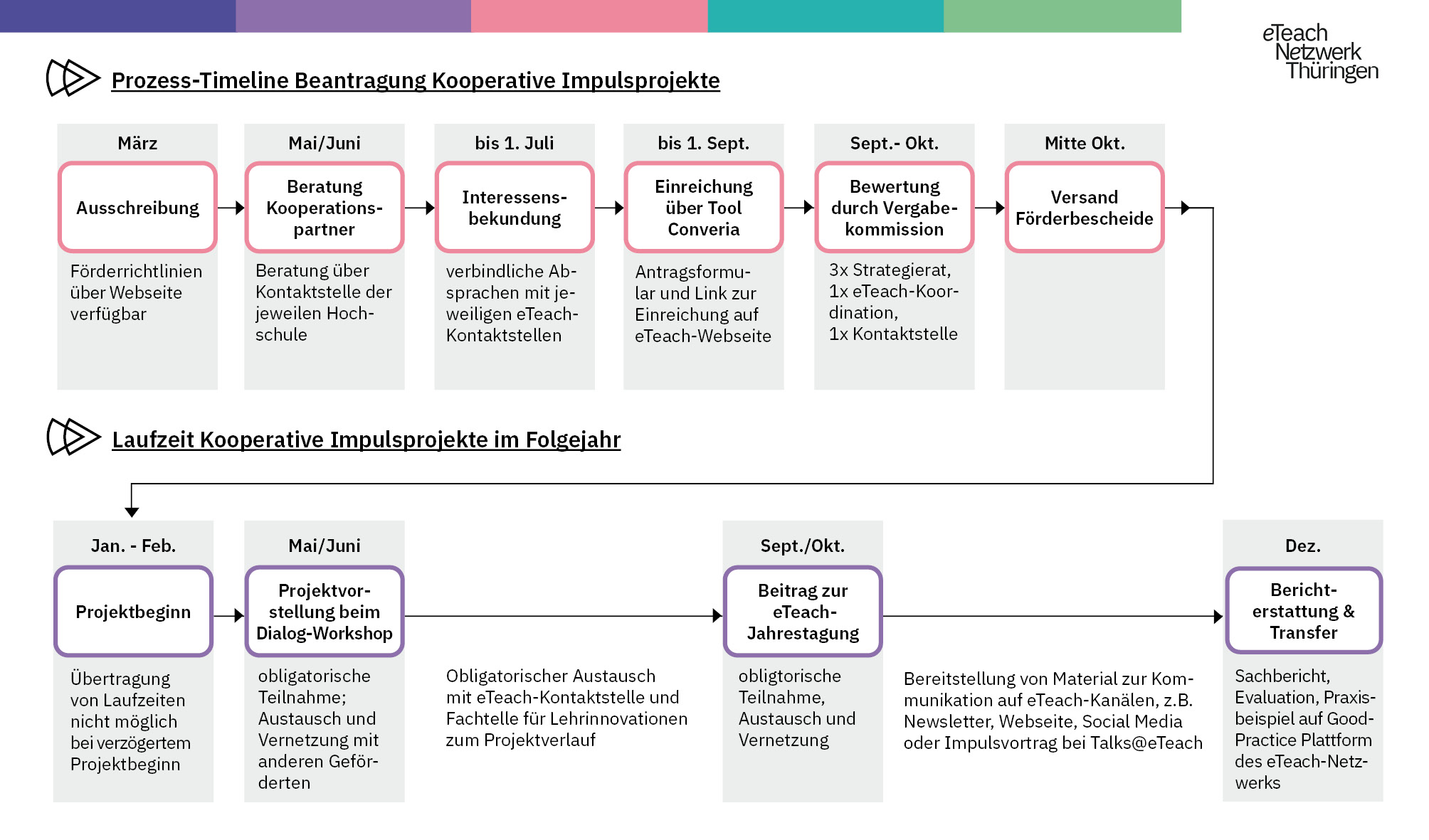
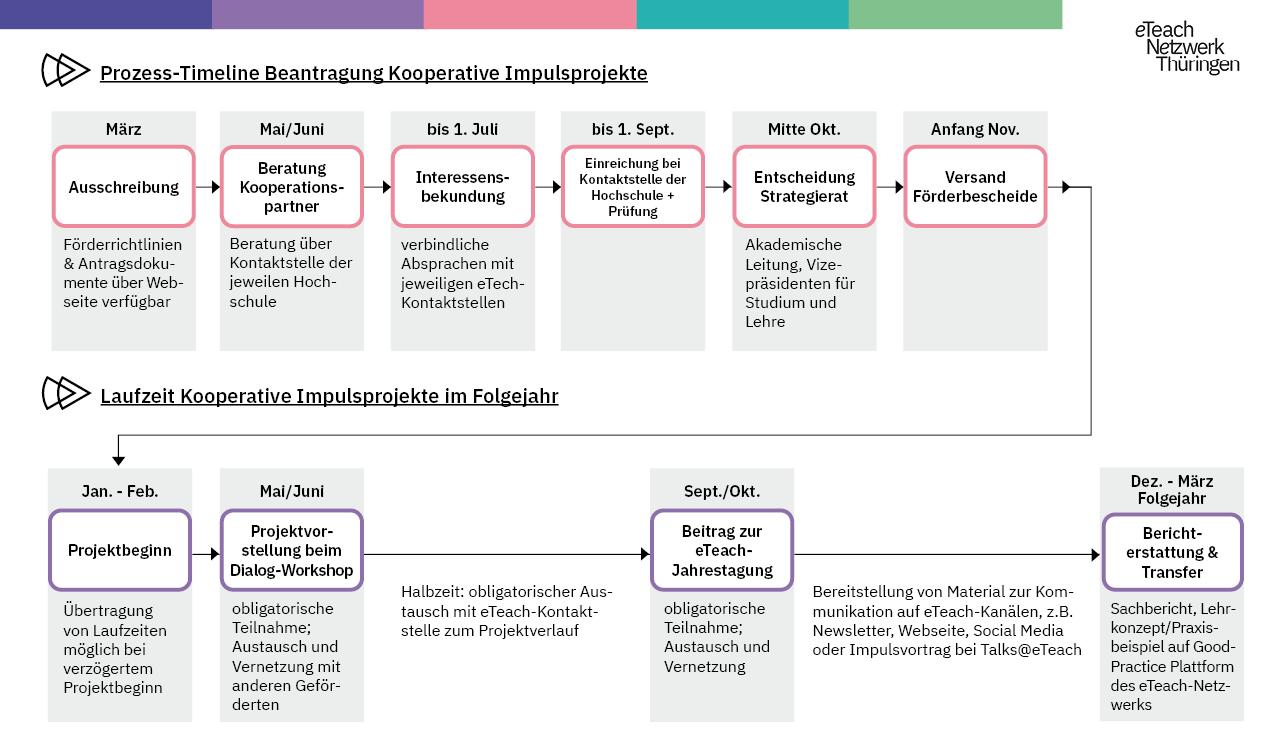
Below you will find a process illustration with a time horizon from the application to the end of the funding period as well as all necessary documents for the application.

Important documents for your application.
Submission Process
Submissions will be accepted starting July 1 through September 1 via the Converia platform.
To submit your application, please use the application form, which you can download from the Downloads section. You must then upload the completed form using the Converia submission tool.
Please note that an expression of interest to your eTeach contact point is a prerequisite for an application.
Here's how to submit a request through Converia:
- Register once in Converia. For Cooperative Impulse Projects, it is sufficient for the lead applicant to register and submit the application. Additional co-applicants can be added after the application has been uploaded.
- Upload your application as a PDF via the portal.
- Once your submission has been successfully processed, you will receive a confirmation.
FAQ on applying for impulse projects
Who is eligible to apply?
Faculty members at Thuringian universities—that is, professors and academic staff with teaching responsibilities—are eligible to apply. Staff members without teaching responsibilities, adjunct instructors, and individuals who work directly within the eTeach network are not eligible to apply.
***
As a (former) eTeach grantee, can I submit another application?
Yes, even as a (formerr) eTeach grantees*You may submit a new application. Please note, however, that funding is not available to continue projects that have already been completed. The new project must therefore demonstrate a clearly recognizable degree of innovation and meet the current funding criteria.
***
Can a rejected application from a previous tender round be resubmitted in the same or a similar form?
Yes, rejected proposals may generally be resubmitted. In doing so, applicants should take into account the feedback from the previous review as well as any necessary adjustments regarding format, content, and/or funding. Please also refer to the current funding guidelines. Of particular importance this year are the contribution to promoting future skills and measures for transferring the results.
***
Can I submit an application for multiple funding programs (Freiräume and Cooperative Impulse Projects)?
Yes, applications can generally be submitted under multiple funding programs. However, funding can be awarded to each person under only one funding program.
***
Are multiple applications per university permitted?
Yes, multiple applications per institution are permitted. It is expressly recommended that no competitive preselection be conducted within the institution.
***
Can I also collaborate with a university in another federal state?
Collaborations are always possible and encouraged. However, to qualify for funding under the eTeach Initiative Projects, at least two project partners from different Thuringian universities must participate, as personnel and material resources can be awarded exclusively to full-time faculty members at Thuringian universities. In addition, other collaboration partners from other federal states may be involved.
Do I need to contact my eTeach liaison before submitting my application?
Yes. We recommend contacting the relevant eTeach contact point well in advance to submit your application. In any case, an informal expression of interest must be submitted there by July 1, 2026.
***
What should I pay special attention to when submitting my application?
Evaluation is based on the funding criteria published in the funding guidelines. Of particular importance this year are the contribution to the promotion of future skills and measures to transfer the results.
***
Which institution is the applicant institution for cooperative initiative projects?
Formally, there must be an applicant who, if funding is awarded, will serve as the point of contact and project manager for the funded project. The funds are allocated in equal shares to the two collaborating universities.
***
How and where are the application documents submitted?
To submit an application, please use the application form available on the eTeach Network Thuringia website. The completed form must then be uploaded via the Converia submission tool by September 1, 26. This requires the lead applicant to complete a brief registration in the system.
***
In which language should the application be submitted?
Submissions should preferably be in German. Submissions in English are also accepted.
***
Do all the questions on the application have to be answered?
Yes, you must answer all the questions in the application, as this is a requirement for meeting the eligibility criteria.
***
What documents must be submitted to apply for project funding?
For eTeach Open Projects, only the completed and signed project application must be submitted. For Cooperative Initiative Projects, statements from the university administrations are required in addition to the completed application. These are obtained by the respective eTeach contact points and forwarded directly to the eTeach Coordination Office, which attaches them to the application.
***
For a Cooperative Impulse Project, does the financial plan need to specify in detail how the project partners will divide the grant funds among themselves?
No. In Cooperative Impulse Projects, the funds provided are divided equally (50 % each) among the participating universities. This amounts to €1,250 per university in in-kind funding. The specific use and allocation of in-kind resources within the project is the responsibility of the project partners.
Can funding be requested to cover additional positions, or is the primary purpose of this funding to enable applicants to reduce their teaching load? If additional staff can be hired to work on the initiative projects, the question arises as to whether these positions must be filled at the beginning of the respective funding year or only later in the year.
The personnel funds may be used to adjust or increase the workload of academic staff or to hire new academic staff.
Ideally, the positions should be filled at the beginning of the funding period in order to fully utilize the available budget within the respective funding year. Funding ends no later than December 31, 2027.
***
Up to which classification level can I apply for personnel funds?
It is assumed that the projects will be carried out by research assistants with the appropriate qualifications, who are typically compensated up to pay grade E13 under the TV-L collective bargaining agreement. The allocation of personnel funds across multiple part-time positions or the splitting of funding over time should be avoided. Funding is provided based on actual personnel costs up to a maximum of €42,000 (corresponding to an E13/3 position). When applying for higher pay grades, the necessity must be explicitly justified. In such cases, the position’s percentage or the duration of the position must be adjusted in light of the available budget per funded project. Please contact the coordination office in advance regarding this matter.
***
How can staff positions be shared between the cooperation partners?
A maximum of one staff position per project may be funded for one year. This means you can apply for either one half-time position per university for one year or one full-time position per university for half a year. If you are planning a collaboration with more than two partners, please contact the eTeach coordination team in advance.
***
In inter-university projects, who is the employer of the funded employees?
The contracts for the individuals to be hired are concluded with the university where they will be working. The approved personnel funds will be made available to the universities in full in advance. Settlement with the eTeach Coordination Office must take place no later than one month after the project’s completion. Proof of the actual personnel expenses incurred must be provided at that time. Any unused funds must be repaid to the eTeach Coordination Office.
***
Should the project staff member also provide instruction as part of the project—and if so, only as part of testing the formats that have been developed?
The pilot projects should be viewed as an addendum. The practical implementation of the project can be tested within the context of teaching. However, the goal is not to (co-)fund regular courses through the pilot projects. Rather, the focus is on the development, testing, and transfer of innovative formats. The project results therefore do not need to be fully developed teaching formats; intermediate steps, prototypes, or individual modules or components of courses are expressly permitted and encouraged.
***
Can I apply for material resources for student assistants?
Yes, this is possible. Please justify the need for funding in the application by outlining the main tasks of the student assistant. The tasks must make a clear contribution to the project. Under "Title", state the degree of the student assistant and the planned number of hours, e.g. "BA, 6 x 20h".
***
Can special literature be purchased from the material resources or does this have to be done using the basic equipment of my university?
Yes, this is possible. The prerequisite is that the literature is not available elsewhere, e.g. via the university library. Its procurement should represent added value for the project and be conducive to the results.
How are projects selected?
Submitted project proposals are reviewed by an internal award committee. This committee is appointed by the eTeach Strategy Council and consists of three members of the Strategy Council, a representative from the eTeach Coordination Office, and an eTeach contact person. The evaluation is based on a scoring table and the selection criteria transparently published in the funding guidelines. Each member of the award committee submits a funding recommendation, which may be accompanied by notes, recommendations, or conditions. The final decision on whether to fund the projects is then made by the Strategy Council.
***
What formal reasons lead to the rejection of an application?
Through its “Impulse Projects,” the eTeach Network Thuringia aims to promote innovative initiatives in the areas of learning, teaching, and assessment, and to make the application process as straightforward as possible. However, for reasons related to funding and procurement regulations, certain formal requirements must be strictly adhered to:
- Cooperation between Universities: The pilot projects require collaboration between at least two faculty members from different universities in Thuringia. Individual applications are not eligible for funding.
- Eligibility: Full-time faculty members at Thuringian universities are eligible to apply, in particular professors, academic staff with teaching responsibilities, and instructors for special assignments (LfbA/LbA).
- Reasonable Financial Planning: The requested personnel and material resources must fall within the specified funding limits and be supported by clear and verifiable justification.
- Use of the Application Form: Only the application form provided may be used to submit an application.
- Completeness of the Application: All required information must be provided in full. Please observe the specified character limits. If you have any questions, the eTeach Coordination Team or the contact points will be happy to assist you in advance.
- Submission by the Deadline: The application must be submitted via the Converia submission portal within the published deadline. Applications received after the deadline can only be considered in the next call for proposals.
- Approval from University Administration: Funding can only be provided if approval has been obtained from the university administration. Once an application is received, the respective eTeach contact points will be notified so that they can obtain approval from the university administration.
***
When can we expect a decision on funding?
All applicants will be notified by the end of October 2026 at the latest whether their project will receive funding.
***
How do I find out if my application will be funded?
Once the evaluation and award process is complete, the decisions regarding funding or rejection will be sent via email to the applicant’s email address provided in the application.
***
When is the earliest the funding can begin?
The funding is scheduled to begin on January 1, 2027, if possible.
***
How long can the funding period covered by the application be?
The funding period is six months for eTeach-Freiräume projects and 12 months for Cooperative Impulse Projects. Funding ends no later than December 31, 2027.
***
How are the funds allocated?
The approved funding is made available to the universities in full in advance. Settlement with the eTeach Coordination Office must take place no later than one month after the project’s completion. Proof of the actual expenses incurred must be provided at that time. Any unused or overpaid funding must be repaid to the eTeach Coordination Office.
***
What happens if changes arise during the project?
Should any significant changes arise regarding the project plan or the use of the grant funds, these must be coordinated with the eTeach coordination team at an early stage.
To what extent should grant recipients be involved in the network and participate actively?
The project results are to be made available to all interested parties at Thuringian universities. For this reason, grant recipients are encouraged to develop ideas for processing, making available, and ensuring the interoperability of their results even while the project is still underway.
The involvement of grant recipients takes place primarily through the following formats:
- Regular communication with the contact points: The contact point is kept continuously informed about the project’s status and any changes in staffing or the actual project start date, and provides guidance throughout the project. If necessary, grant recipients may contact the contact point or the eTeach coordination team at any time.
- Exchange Meetings During the Project: Exchange meetings bring together project participants, the eTeach coordination team, and contact persons from the participating universities. These meetings are initiated by the eTeach coordination team and can serve as a kick-off at the start of the project, as a mid-project review, and as a wrap-up meeting to prepare for the transfer and dissemination of results.
- „Im Dialog“ Workshop (annual, in cooperation with the Stifterverband): This networking workshop is designed to facilitate exchange between grant recipients and interested parties. Participation, as well as the presentation of projects in the form of a poster and a pitch, is mandatory during the grant period.
- eTeach Annual Conference: This annual conference showcases teaching innovations from funded projects and promotes cross-institutional discourse on digital higher education. Funded participants are required to submit a presentation (at least one poster).
- Project Completion and Documentation of Results: Upon completion of the project, a technical report must be submitted to the eTeach coordination team. In addition, the results must be made available in an appropriate format—such as a practical example or a teaching/learning concept—on the eTeach Network’s Good Practice Platform.
The eTeach Coordination team coordinates the various contributions and collaborations and invites the grant recipients to participate in the relevant events.
***
How are the project results made visible and accessible across universities? What opportunities for knowledge transfer does the eTeach Network Thuringia offer?
The options for transferring and disseminating project results depend on the objectives and specific characteristics of each project. The eTeach Network Thuringia is open to various forms of results dissemination, provided that they enable sustainable transfer and are practicable for project participants. For this reason, initial considerations regarding the dissemination and reuse of results are requested as early as the application stage.
The eTeach Network Thuringia actively supports the dissemination of project results. In particular, the annual eTeach conference provides a platform for presenting funded projects, exchanging experiences, and creating opportunities for collaboration among faculty members at all Thuringian universities. In addition, workshops can be used to present project results and provide an introduction to their application.
Furthermore, all project participants are required to share their experiences and results in an appropriate format—as a practical example or a teaching/learning concept—on the Good Practice Platform to the eTeach network. This can take the form of, for example, a practical example, a teaching/learning concept, a tutorial, a Moodle course room, a collection of materials, or a workshop concept. The goal is to make the results as easily accessible as possible to other instructors and to encourage their reuse.
The processing and dissemination of the project results will be carried out in coordination with the relevant contact points and the eTeach coordination team and should be completed no later than three months after the end of the project.
***
Who prepares the final report, and what are the reporting requirements?
The final report is prepared by the grant recipients. The eTeach Coordination Office or the contact points can provide support in this process. The final report describes and reflects on the course of the project and the results achieved. To assist with the preparation of the report, the eTeach Coordination Office will provide grantees with a template containing relevant guiding questions at the end of the project. The final report and the statement of funds used must be submitted to the eTeach Coordination Office no later than one month after the end of the project.
In addition, once the funded projects are completed, they will be evaluated with regard to the process—from the application stage and its funding terms through to the end of the project. The evaluation form will be sent out after the project ends and should be completed by all project leaders. The results of the evaluation will be used to further develop the “Impulse Projects” initiative and to gain insights into the process.

Knowledge transfer and cooperation requests
It is important to us that your findings and results can be used by other teachers at Thuringian universities. We therefore ask you to think about the transfer to other contexts, other disciplines and other universities when planning your project. Find partners at other universities to test the transfer during the course of the project and benefit from the synergies.
These are our funded projects.
Projects in the 2026 funding round
In the project OCAASinitiated by Prof. Dr.-Ing. Falk Liebold (Gera-Eisenach Cooperative State University) and Prof. Dr. Holger Cartarius (Friedrich Schiller University Jena)an innovative digital system for continuous skills diagnostics in STEM degree programs is being developed. The starting point is the challenge that the current examination landscape is strongly focused on a single summative final examination, while weekly exercises often only cover partial aspects and hardly provide any quick, transparent feedback. This leads to exam stress and makes it difficult for students to prepare in a skills-oriented way.
OCAAS is intended as a modular Moodle plugin enable continuous, formative feedback. An interactive dashboard - visualized as a spider web diagram - gives students an insight into their professional and methodological skills, such as theoretical understanding, transferability and problem-solving skills.
The system extends existing Moodle functionalities with complex task types typical for science and technology and combines classic tasks, transfer tasks, formative tests and self-reflection. Teachers can use anonymized progress data to adapt their teaching formats in a targeted manner.
OCAAS is a tool that creates transparency in the learning process, promotes competence-oriented work and reduces exam stress - and can also be easily transferred to other subjects.
In the project KI-TuPr Linitiated by Prof. Rolf Kruse (FH Erfurt) and Dr. Hasnain Bokhari (University of Erfurt)The project examines how artificial intelligence can be meaningfully integrated into project-based university teaching. AI is profoundly changing learning processes - at the same time, there is a risk that students will produce results without building up a real understanding.
The project is therefore developing didactic methods and models that will enable students to use AI in a reflective and responsible manner and ensure sustainable learning success. The focus is on a digital AI tutorwhich accompanies learning processes adaptively and offers both technical and methodological support.
The AI tutor is being implemented as a prototype, tested in courses and scientifically evaluated. The innovation of the project lies in the combination of technological assistance with didactic reflection - an approach that strengthens AI literacy, collaborative work and self-directed, project-based learning.
Under the direction of Dr. Dagmar Brand (University of Erfurt) and Dr.-Ing. Stefan Griebel (TU Ilmenau) teacher training and technology students from both universities are working together to develop child-friendly approaches to technology. In the project, interdisciplinary teams are developing tried-and-tested teaching concepts that teach digital education and initial programming skills in an age-appropriate way - embedded in mathematics, science and handicrafts lessons.
On the basis of Lego Education and Circuit Cubes affordable, adaptable materials are developed that strengthen both the technical and digital skills of primary school children. At the same time, students gain valuable practical experience.
The results flow as open educational resources (OER) into teaching and teacher training and create sustainable synergies between the two universities. The project combines innovative programming materials with the Thuringian curricula and demonstrates a sustainable model for future-oriented STEM promotion in elementary school.
Projects in the 2025 funding round
The project "Immersive Media for Practical and Active Classroom Training" (IMPACT) is a joint project of Prof. Dr. Wolfgang Broll of the Ilmenau University of Technology and of Prof. Dr. Ulf Sauerbrey of the University of Erfurt. The aim is to develop and use immersive media and virtual reality (VR) technologies for practical and active learning in the classroom. The aim is to improve interaction in virtual classrooms and support teaching methods with modern VR technologies.
>>> Click here for the detailed project report on the Good Practice Platform
The project "Learning With Water: Between Land-Based Learning and E-Portfolio" between Jun.-Prof. Dr. Alexandra Toland from the Bauhaus University Weimar and Prof. Dr. Caroline Rosenthal from the Friedrich Schiller University Jena is working on innovative approaches to imparting knowledge about water resources and their sustainable use. The aim is to combine traditional educational models with digital methods and to raise awareness of the interactions between ecological and social aspects of water. An approach is being pursued that integrates both land-based learning and the use of e-portfolios. This should enable learners to understand the importance of water not only as a resource, but as a central component of ecosystems and social structures.
>>> Click here for the detailed project report on the Good Practice Platform
The project "Analysis of the use of history education portals to promote practical relevance in computer science and history teaching studies" will be organized by the teachers Prof. Dr. Anke John from the Friedrich Schiller University Jena and Prof. Dr. Marcel Spehr is being carried out by the Erfurt University of Applied Sciences. The project investigates how digital history portals, such as the German Newspaper Portal or other digital collections, can be used in teacher training to strengthen the link between theory and practice. The aim is to familiarize future teachers with methodological approaches to using such portals for history lessons and to promote technological skills at the same time. There is a particular focus on the combination of computer science and history didactic elements in order to develop innovative and practice-oriented teaching methods.
>>> Click here for the detailed project report on the Good Practice Platform.
The classification of the ICF (WHO, 2001) as a bio-psycho-social model is becoming increasingly important in educational, social and therapeutic contexts. To date, there is no attractive digital, multimedia self-learning concept for its practical application. ICF! is a competence-oriented modular self-learning concept that is developed in an interdisciplinary and participatory manner. Students acquire case-oriented knowledge and skills to establish routines for practical application. The project is organized by Prof. Dr. Sandra Neumann from the University of Erfurt and Prof. Dr. Andreas Seidel from Nordhausen University of Applied Sciences and all content will subsequently be available as OER.
Click here for the detailed project report on the Good Practice Platform.
Projects in the 2024 funding round
Topic: LogDesignBuild Suhl. Weak wood in the didactic-digital chain forest-design-build. Applicant: Prof. Frank Bauer, University of Applied Sciences Erfurt. Cooperation partner: Junior Professor Dr. Thomas Pearce, Bauhaus University Weimar.
Topic: Oral history in the historical subjects; cooperation partners: Dr. Axel Doßmann (Friedrich Schiller University Jena) and Dr. Agnès Arp, University of Erfurt.
Topic: Situated learning in social-virtual reality in teacher training. Applicant: Prof. Dr. Wolfgang Broll, Ilmenau University of Technology. Cooperation partner: Prof. Dr. Gerd Mannhaupt, University of Erfurt.
Projects in the 2023 funding round
Topic: Transfer of a self-developed learning assessment of students to other technical Bachelor's degree courses at the University of Erfurt and the DHGE. Applicant: Prof. Dr.-Ing. Christian Döbel, Gera-Eisenach Cooperative State UniversityCooperation partner: Prof. Dr. Waldemar Bauer, University of Erfurt
Topic: Consolidation of the Immersive Learning Platform Thuringia (ILT+) Applicant: Prof. Rolf Kruse, University of Applied Sciences ErfurtCooperation partner: Prof. Dr. rer. nat. Wolfgang Broll, Ilmenau University of Technology
Topic: Silent Places - Safe Spaces: Space, Urbanity and Spirituality in a Transcultural Setting. Applicant: Prof. Dr. Katharina Waldner, University of ErfurtCooperation partner: Prof. Dr.-Ing. Doris Gstach, University of Applied Sciences Erfurt.
Topic: GeViLab - Joint virtual laboratory visits for large-scale and special experiments. Applicant: Junior Professor Dr. Lars Abrahamczyk, Bauhaus University WeimarCooperation partner: Prof. Rolf Kruse, University of Applied Sciences Erfurt.
Topic: International Urban Design Hackathon - Exploring aesthetics of sustainability Collaboration of online urban design teaching and empirical communication research (STADTKOMM). Applicant: Dr. Steffen de Rudder, Bauhaus University WeimarCooperation partner: Prof. Dr. Jens Wolling, Ilmenau University of Technology.
Topic: Further development of the digital laboratory for usability in inter-university and interdisciplinary remote-based hybrid teaching. Applicant: Prof. Dr.-Ing. Falk Liebold, Gera-Eisenach Cooperative State UniversityCooperation partner: Dr.-Ing. Prof. h. c. Karsten Henke, Ilmenau University of Technology.
Projects in the second funding round 2022
Topic: Concept and application (long-term goal app) to expand the practical experience with a choir in the curriculum and to build up additional targeted listening experience. Applicant: Prof. Juan Miguel Verdugo Garcia, Franz Liszt University of Music WeimarCooperation partner: Martin Bosch, University of Erfurt.
Topic: Development of moodle-based OER for media-related school development in the context of media pedagogical competence promotion in teacher training programs. Applicant: Prof. Dr. Sven Jöckel, University of Erfurt, cooperation partner: Prof. Dr. Nils Berkemeyer, Friedrich Schiller University Jena.
Topic: Cross-media integration of audiovisual archive holdings in transcultural music research: Innovative approaches to image and sound material to enrich university teaching scenarios Applicant: Prof. Dr. Tiago de Oliveira Pinto, Franz Liszt School of Music, Weimar, cooperation partner: Prof. Jakob Hüfner, Bauhaus University Weimar.
Projects of the first funding round 2022
Topic: Hybrid teaching and learning environment for virtual product development Applicant: Prof. Dr.-Ing. Stephan Husung, Ilmenau University of Technology, Cooperation partner: Prof. Dr.-Ing. Folker Flüggen, Nordhausen University of Applied Sciences.
Topic: Consolidation of the Immersive Learning Platform Thuringia (ILT+) Applicant: Prof. Rolf Kruse, University of Applied Sciences ErfurtCooperation partner: Prof. Dr. rer. nat. Wolfgang Broll, Ilmenau University of Technology
Topic: Sacred spaces in Erfurt. Applicant: Prof. Dr. Katharina Waldner, University of Erfurt. Cooperation partners: Prof. Dr.-Ing. Doris Gstach, University of Applied Sciences Erfurt and Dr. Silke Martin, University of Erfurt.
Topic: 360° Escape Rooms. Applicant: Prof. Dr.-Ing. Christian Springer, Erfurt University of Applied Sciences. Cooperation partner: Prof. Dr.-Ing. Jörg Londong, Bauhaus University Weimar