At many universities, future skills are listed as a set of competencies separate from the actual degree program—for example, as an additional module or an elective. How, instead, can they be integrated into the structure of a degree program?
The talk highlights the „Mechanical Engineering – Product Engineering and Context (MPEC)“ program at the Cologne University of Applied Sciences, which is just entering its fifth cohort.
The foundation is the design principle of „induced learning.“ Based on the graduate profile, frameworks for action are designed in which students experience the limits of their current scope of action and, as a result, identify their own learning needs. Motivation thus arises from the learning process itself, rather than being imposed from the outside. Initial experience with this approach comes from the „IX-trinsisch – Learning Through the Countercurrent Method“ format, which Prof. Tiltmann has been using since 2014 to implement project-based learning in large groups.
This article examines how this is changing assignments, exams, the role of instructors, and the teaching of foundational concepts, and what role AI plays in this process.
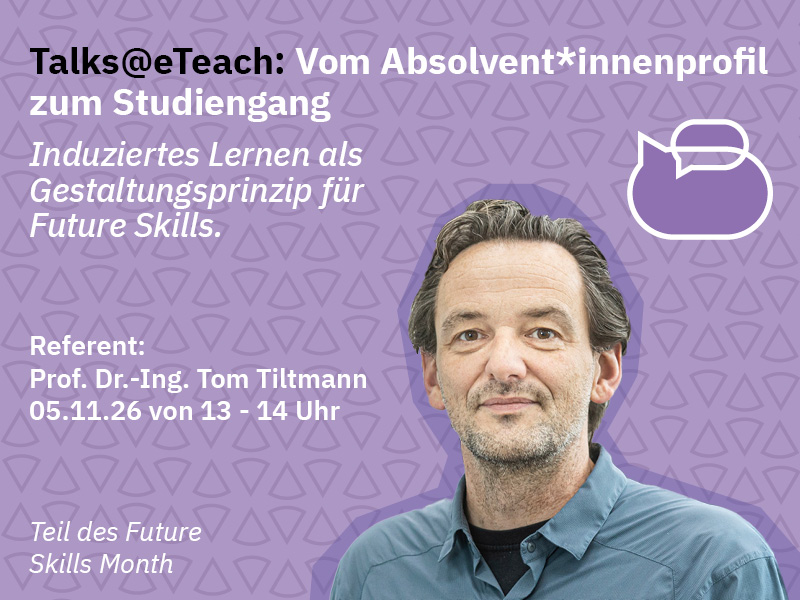
Prof. Dr.-Ing. Tom Tiltmann is a professor of information technology and process modeling at the Cologne University of Applied Sciences. Drawing on his many years of engineering experience in industrial and development projects, he explores how learning can be made more natural and effective. Together with colleagues, he has developed the design principle of „Induced Learning“ for this purpose: learning situations are designed so that students themselves recognize their learning needs and become motivated. The incorporation of real-world work practices from the field is a central design element in this approach. Since 2014, he has been implementing project-based learning in the introductory phase of the program with large groups, using the „IX-trinsisch – Learning in a Counter-Current Process“ format. Today, this principle shapes the „Mechanical Engineering – Product Engineering and Context (MPEC)“ program, which is now entering its fifth cohort.
Event information: The conference room opens 15 minutes before the event begins. Please keep your microphone and camera turned off when entering the room. The event will be recorded.
Talks@eTeach is a format of the eTeach network Thuringia, which offers space for impulses from teaching practice, exchange of experience and networking on the subject of media-enhanced teaching, learning and testing.The events take place every two months in hybrid form or online and are aimed at lecturers, students and interested parties. >>> Click here to view more past talks.