
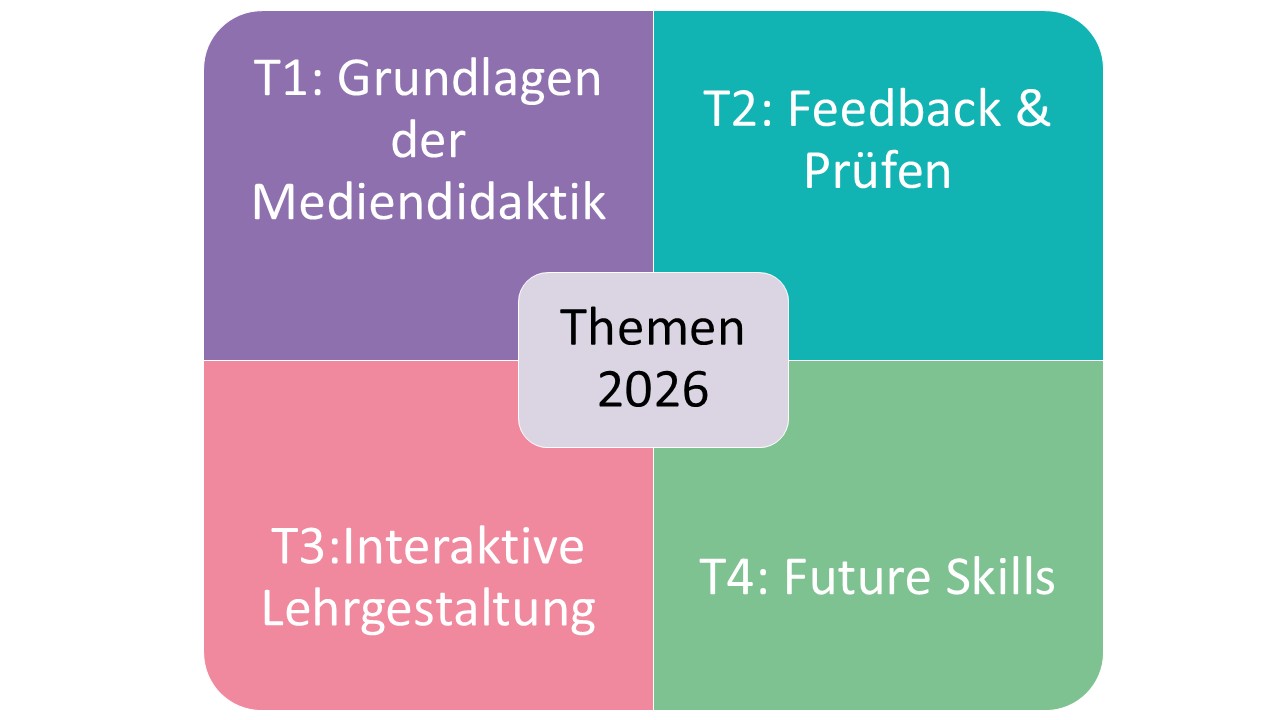
With the eTeach course program, we offer a thematic spectrum that is divided into four areas in 2026:
- T1: Basics of media didactics
Introduction to media didactic concepts, hybrid teaching settings and the legal and technical foundations of digital teaching. - T2: Feedback and testing
Design of digital examination and feedback formats, formative and summative examinations as well as possibilities for reflective learning support. - T3: Interactive teaching design
Methods and tools for activation and collaboration in digital and hybrid teaching settings, such as inverted classroom, collaborative Moodle scenarios or H5P. - T4: Future Skills
Perspectives on future requirements of academic teaching, including AI skills, digital resilience, agile methods and dealing with uncertainty.
Core target group of the eTeach courses are lecturers at Thuringian universities. We also welcome participants who work in competence centers and service areas as well as professors and newly appointed professors at Thuringian universities.
The eTeach courses take place in presence, hybrid or online (conference platform BigBlueButton). You will receive the relevant information via the course description or in advance of the event. We endeavor to meet the possibilities of our lecturers and the needs of the participants and act flexibly as required. All courses are concluded with an evaluation at the end, which you can use to leave feedback on the course.
Individual events include either:
- 2 work units (WU)
corresponding to 1.5 hours
or
- 4 work units (WU)
corresponding to 3 hours.
The courses can be attended flexibly and subject-specifically. Those who have completed at least 8 work units also receives a thematic collective certificate.
Registration takes place via the Congeno portal. A personal account should be created first.
The portal is then used to:
- the course registration,
- the evaluation of the events
- and the provision of certificates of participation
organized.
Certificates of attendance are issued for the individual events attended. In addition, a collective certificate can be acquired if there is sufficient coverage within a subject area.
As the number of places in individual events may be limited, please cancel in good time if you are unable to attend.
Contents
LaTeX (pronounced La-tech) is a language for creating documents. This introductory course explains the basic principles and functionality of LaTeX, which has become the de facto standard for scientific publications, particularly in the STEM field.
After attending the course, participants will be able to create documents with LaTeX, manage references and citations with BibTex, set mathematical formulas and adapt the layout of LaTeX documents.
Learning objectives
- Get to know the basics and functionality of LaTeX
- Creating documents with LaTeX (e.g. articles, reports or minutes)
- Central LaTeX commands for structuring texts, sections, lists, tables and figures
- Correct setting of mathematical formulas and equations with LaTeX
- Customizing the layout and design of LaTeX documents
- Reflecting on the potential of LaTeX for scientific work
Speaker:
Ludwig Lorenz

Click here to go to the Registration.
This course has been canceled; a make-up session will be held in the spring.
Contents: The course is aimed at teachers who want to clarify for their own course which media skills students actually need in their subject. The focus is not on the general use of tools, but on the subject-specific question: Which digital, media and AI-related skills are essential for students to be able to work successfully in my course?
After a brief introduction to the concept of media competence, in particular Baacke's dimensions of media criticism, media studies, media use and media design, current competence frameworks such as DigComp and DigCompEdu are presented as orientation aids. They serve to structure and specify students' own expectations.
The focus is on practical work: participants reflect on their own course, identify key media-related requirements of their subject and draft initial subject-specific competence objectives. This can then be used to create a short questionnaire or an introductory task that teachers can use to determine what prerequisites students have and where there is a need for support.
Learning objectives: After completing the course, participants can:
- classify the concept of media literacy in basic terms and relate it to university teaching,
- distinguish between general digital operating skills and subject-specific media skills,
- name central media-related requirements of their own course,
- use DigComp and DigCompEdu to select suitable areas of competence for their own subject context,
- formulate initial subject-specific media competence goals for their own teaching,
- decide which media skills they can assume students have and which should be actively promoted in the course,
- Develop initial questions for a short online questionnaire or a reflection task
- derive didactic consequences from the results of such a query, for example for tasks, materials, AI rules or research exercises.
Speaker:
Uwe Cämmerer-Seibel

Minimum/maximum number of participants: 6/16
Necessary prior knowledge:
No in-depth prior knowledge of media education required. Basic experience with media-enriched teaching, learning platforms or AI tools is helpful, but not a prerequisite. It is important that participants bring a specific course or teaching scenario with them. The course works best when teachers can work directly on their own example, such as a seminar, a lecture, a practical course, a project module or an exercise.
Contents: The workshop „Designing hybrid teaching settings“ is aimed at lecturers who want to develop their courses flexibly between face-to-face and online formats. At the beginning, basic terms are clarified and different scenarios of hybrid teaching are presented. Building on this, participants will receive an overview of technical settings, requirements and concrete examples of implementation from Thuringian universities.
One focus is on reflecting on personal experiences and classifying the advantages and disadvantages of hybrid teaching compared to pure face-to-face and online formats. In addition, didactic and methodological challenges will be discussed, in particular strategies for promoting interaction, activation and engagement in hybrid learning environments.
Finally, the workshop raises awareness of data protection aspects in hybrid teaching/learning settings and encourages a critical examination of legal and practical issues.
Learning objectives: Participants know what is meant by „hybrid teaching“ and are familiar with different concepts. They reflect on their own experiences with hybrid teaching/learning settings and understand the advantages and disadvantages of hybrid teaching in the context of face-to-face and online teaching. - Participants are familiar with various technical settings for implementing hybrid teaching, know about technical requirements and possibilities and have become familiar with concrete examples of implementation at Thuringian universities. - They know and understand the methodological and didactic challenges of hybrid teaching and are particularly aware of ways to promote interaction and engagement. Participants know and reflect on data protection issues in the context of hybrid teaching/learning settings.
Speaker:
Dr. Petra Lepetit

Minimum/maximum number of participants: min. 6, open at the top
Necessary prior knowledge: No prior knowledge necessary
Click here to go to the Registration.
Contents
AI applications such as ChatGPT or image-generating systems are becoming an increasingly common part of everyday life at universities. They open up new possibilities for designing courses, but at the same time raise questions about copyright and data protection. What is permitted when using AI in teaching? What data may be processed? Who owns AI-generated content? And how can instructors integrate AI into their courses in a way that complies with data protection regulations and is legally sound?
The course covers the legal foundations for the use of AI in higher education and contextualizes them within typical teaching scenarios. Following an introduction to how AI systems work and the legal framework, the course addresses key aspects of copyright and data protection law. Using practical examples, participants discuss opportunities, risks, and possible courses of action for their own teaching practices. The goal is to design courses in such a way that AI can be used effectively without losing sight of legal requirements.
Learning objectives
After completing the course, participants will be able to
- explain the key legal framework governing the use of AI in higher education,
- classify copyright issues related to the use and creation of AI-generated content,
- take into account data protection requirements when using AI applications in courses,
- identify and assess typical legal risks based on specific teaching scenarios,
- make informed decisions about the use of AI in their own teaching and identify appropriate courses of action.
Speaker: Carsten Morgenroth, Ph.D. in Law
Minimum/maximum number of participants: 5, open at the top
Click here to go to the Registration.
Information will follow.
Information will follow.
Contents
How can students make learning processes visible, network knowledge in a meaningful way and use digital tools for long-term study and research? The course offers an introduction to working with Obsidian as a tool for knowledge management, academic work and reflective learning processes. In addition to the basics of the software, didactic applications in university teaching will be presented and discussed. The focus is on the question of how Obsidian can be used to design formats that accompany the learning process and place a stronger focus on individual development, linking knowledge and critical reflection.
Learning objectives
- Get to know the basics and how obsidian works
- Systematically organize and network your own notes and knowledge bases
- Reflecting on the potential of obsidian for scientific work
- Get to know the possibilities of didactic integration in courses
- Develop approaches for process- and competence-oriented learning formats
- Promote connected learning and reflective handling of information in a digital and AI-influenced context
Speaker:
Ludwig Lorenz
Click here to go to the Registration.
Contents
Easy access to AI applications is fundamentally changing higher education exams. Instructors face the challenge of designing exams in a way that validly assesses competencies while also ensuring transparent and fair use of AI. This raises not only pedagogical but also legal questions: When is the use of AI permissible? What regulations are necessary? And how can exams be adapted to these changing conditions?
The course covers the legal fundamentals of exams as they relate to AI and uses practical examples to illustrate the flexibility universities and instructors have in this area. The focus is on issues related to exam administration, the formulation of AI policies, and how to handle suspected cheating and documentation requirements. Together, we will develop recommendations to help instructors design exams that are legally sound and future-proof.
Learning objectives
After completing the course, participants will be able to
- explain the legal framework for the use of AI in exams,
- assess the impact of AI on different exam formats,
- take into account examination regulations when designing and administering exams,
- formulate transparent guidelines on the permissible use of AI in their courses,
- Further develop exams in a way that is pedagogically sound and legally sound, given the current state of AI technology.
Speaker: Carsten Morgenroth, Ph.D. in Law
Minimum/maximum number of participants: 5, open at the top
Click here to go to the Registration.
Contents:
There are many ways to assess students digitally, and this depends just as much on instructional objectives as it does on technical, organizational, and legal frameworks. In this concise, practical workshop, instructors who design exams will gain an overview of current media-based teaching options and trends. They will learn how to implement formative and summative assessment in Moodle, including adaptive settings, as well as automatic, manual, and peer feedback.
Learning objectives:
Upon completion, participants will be familiar with various types and formats of assessments and will be able to incorporate a range of concepts into the design of assessments, as well as independently plan digital assessments, create Moodle tests, provide targeted feedback, and make informed judgments about the opportunities and limitations of digital assessment methods.
Necessary prior knowledge: Moodle Basics
Speaker: Dr. Petra Lepetit
Minimum/maximum number of participants: 8, open at the top
Click here to go to the Registration.
Information will follow.
Information will follow.
Contents:
It's better to learn together - but how can this be implemented in the digital university environment? This workshop will give you practical answers and show you how you can motivate your students to work together in Moodle.
We will start with a brief theoretical impulse on why collaborative learning is superior to the passive reception of content - and what this means for your course design. We will then look at the conditions for successful collaboration.
The focus of the workshop is on concrete work in Moodle. Using tried and tested example tasks, we will explore together how you can guide learning groups in a targeted manner, design forums through targeted moderation and peer review elements to promote learning, integrate collaborative writing tools such as Etherpads or digital whiteboards in a meaningful way and enable structured mutual feedback.
This allows you to work with concrete scenarios from university teaching and gives you the opportunity to try out the tools directly.
Learning objectives:
After the event, participants can:
- the Added value of collaborative learning for the learning process of your students and justify them didactically.
- Methods of collaboration in Moodle and guide your students competently in the process.
- selected Moodle activities for collaboration to your own teaching context.
Minimum/maximum number of participants: min. 8, max. 25
Necessary prior knowledge:
Basic knowledge of Moodle or participation in the »Moodle Basics« course
Speakers:
Larissa Barth and Dr. Nicole Baron


Click here to go to the Registration.
Contents:
With the digitalization of society, new possibilities for teaching and learning are also finding their way into classrooms, seminar rooms and lecture halls. The workshop will provide participants with an introductory overview of the theoretical foundations of „e-didactics“, with a particular focus on learning theories for digital spaces (e.g. Siemens 2004) and insights into the design of hybrid teaching spaces. On the basis of these theoretical assumptions, personal experience and practical examples, key success factors of
digital and hybrid teaching settings.
Learning objectives:
The teachers ...
- know central theoretical and didactic
Basics of hybrid and online teaching
- know a variety of didactic principles for
the successful design of hybrid and
digital teaching settings
- are able to apply the findings to their own
Transfer courses
Speaker:
Prof. Dr. Thomas Heun

Click here to go to the Registration.
Contents:
The workshop deals with typical challenges in the inverted classroom and shows practical strategies for their design. The focus is on the didactic planning of the preparation phase, possibilities for activation in the attendance phase and concrete solutions for common problems encountered in teaching practice.
Learning objectives:
After the workshop, participants can ...
- Identify strategies for designing motivating preparation phases and apply them to their own teaching.
- select activating methods for the attendance phase and use them in a targeted manner.
- recognize typical challenges in the inverted classroom and develop suitable solution strategies.
Speaker:
Prof. Dr. Christian Spannagel

Click here to go to the Registration.
Information will follow.
Information will follow.
Contents:
Future skills are considered key competencies for an increasingly complex and dynamic working and living environment. But how can university lecturers specifically promote these skills and make them visible? The workshop offers an introduction to the concept of competence and provides an overview of central future skills models and competence frameworks. It will also address the challenges of operationalization and measurability. The focus is on the question of how future skills can be promoted through didactic design - often not only through content, but especially through teaching and learning methods. Participants will reflect on which skills are already implicitly or explicitly promoted in their own teaching and which activating formats are particularly suitable.
Learning objectives:
After the workshop, participants can ...
- classify central concepts and competence frameworks for future skills,
- identify relevant future skills for their own specialist context,
- reflect on which skills are promoted by their own teaching,
- select and design activating teaching and learning formats to promote future skills,
- Develop ways to make skills development visible
Minimum/maximum number of participants: max. 15
Necessary prior knowledge: No prior knowledge necessary.
Speaker: Claudia Hoffmann
Click here to go to the Registration.
Contents:
Agile teaching and learning environments promote collaborative and self-directed learning. The focus here is on work in student teams. Instructors support students in their group work by providing guidance, advice, and facilitating group processes. They ensure transparency regarding goals, learning content, and methods. In doing so, they use agile methods—such as retrospectives—to reflect on learning processes. This allows instructors and students to, even as the learning process unfolds, Regularly check whether students are meeting the learning objectives (Inspect). Otherwise, the course can be adapted to meet the students' needs (Adapt). Through this iterative process, students continuously move closer to the learning objectives.
In this workshop, you’ll get a brief introduction to the concept of agile teaching and learn how the two agile frameworks—Scrum and Design Thinking—can be applied in the classroom. We’ll also explore the benefits of agile methods such as Kanban boards and retrospectives, and discuss how these methods can be quickly and easily integrated into existing courses to make them more agile. Throughout the workshop, we’ll draw on concrete experiences from courses conducted as part of the „Agile Methods in Digital Courses“ project at Ostfalia HAW. A toolkit of methods (https://blogs.sonia.de/aggit ) offers you a wealth of additional information, best practices, and downloadable resources.
Learning objectives:
After the workshop, participants will be able to…
- Describe the basic principles of agile teaching and its potential for self-directed and collaborative learning processes.
- Classify Scrum and Design Thinking as approaches to course design.
- Use agile methods such as Kanban boards and retrospectives to support learning processes.
Speaker: Andrea Bode
Click here to go to the Registration.
Contents:
Digital teaching and work processes have long been part of everyday university life - and in addition to new opportunities, they often also entail high levels of stress. The online workshop provides university lecturers with the basics of digital stress in a university context and shows practical strategies for dealing with information overload, accessibility and digital work demands in a way that promotes health. The focus is on reflecting on one's own working habits, dealing with interruptions and multitasking as well as designing digital teaching settings that relieve stress. The workshop combines short technical impulses with interactive exercises and exchange formats.
Learning objectives:
After the workshop, participants can ...
- recognize and classify digital stressors in everyday university life,
- reflect on their own digital work and communication patterns,
- identify individual stress factors,
- Apply strategies to reduce digital stress,
- Be more aware of how to deal with information overload, interruptions and accessibility
- derive conducive framework conditions for their own digital work and teaching
Minimum/maximum number of participants: 5-15
Necessary prior knowledge: No prior knowledge required.
Speaker: Olivia Karasek
Click here to go to the Registration.
Contents:
In this course, we will explore the skills that help us find our bearings and take action in uncertain times. Today’s students face high academic demands and a changing world that requires them to constantly adapt. At the same time, looking toward the future can trigger uncertainty and undermine the basic psychological need for guidance and security.
The workshop will therefore focus on aspects of mental health, the development of mental strategies, and group discussions aimed at strengthening tolerance for ambiguity—the ability to cope with uncertainty and ambiguity. Together, we will explore how people individually assess challenging or stressful situations and what options are available for dealing with them constructively. Using typical thought patterns as examples, we’ll identify areas for action and available options, and develop practical strategies for building mental resilience that can be easily integrated into academic life and daily routines.
Learning objectives:
After the workshop, participants can ...
- Understand the significance of mental health, as well as insecurity and the process of adaptation, in the context of college life and social change.
- explain how individual assessments of situations influence how people deal with challenging or uncertain life circumstances.
- Describe tolerance for ambiguity as a competency and explain its relevance to dealing constructively with ambiguity.
- Reflect on and identify typical thought patterns, areas of action, and practical strategies for strengthening mental resilience.
Necessary prior knowledge: No prior knowledge necessary.
Speaker: Markus Schnare
Click here to go to the Registration.
Contents:
In this event we will introduce you to the Basics of the subject area of artificial intelligence in.
You will learn what lies behind Technical terms such as prompt, hallucination, training or temperature and what distinguishes machine learning from traditional computer programs.
It is also important for us to Limitations and risks of AI systems, which will be discussed further in the workshop on AI: ethics and sustainability. You are welcome to bring along specific questions or didactic scenarios that are of interest to you in your everyday teaching.
Learning objectives:
The participants...
understand basic concepts of artificial intelligence and avoid common misconceptions about how it works.
- distinguish between different types and areas of application for AI systems.
are familiar with key technical terms in artificial intelligence (e.g., prompt, hallucination, training, temperature).
can explain bias in the context of AI and apply that understanding to the risks involved in using AI systems.
- can explain the differences between machine learning and traditional rule-based computer programs.
Speaker: Ludwig Lorenz
Click here to go to the Registration.
Disclaimer:
The content of this workshop is of a purely informative and creative nature in order to facilitate your access to AI and to discuss possible uses of AI in the university landscape on the basis of application scenarios. We do not give you any legal freedom of action for your own work at universities and do not present the workshop content as a recommendation for discourse. Since the internal university structures on the subject of AI behave differently, we ask you to always consult with your university if you are interested in using AI tools internally and to inform yourself about GDPR compliance and other legal aspects.
Contents:
How can students be encouraged to reflect (more) consciously on their own learning and actions? And which methods are suitable for this in your own course? In this workshop, you will learn about key models and concepts of reflection and discover how you can integrate reflective processes into your teaching in an even more targeted way. You’ll explore various reflection methods, analyze their potential applications, and select appropriate methods for your own teaching practice. Together, you’ll develop specific opportunities for reflection tailored to your own course and take away ideas that you can implement immediately in your teaching.
Learning objectives:
After the workshop, participants will be able to …
- Identify key models and concepts for reflection.
- Identify the characteristics and steps involved in reflection and analyze different reflection methods in this regard.
- Select and justify at least two methods for fostering reflective competence in their teaching.
- Further develop a course to include appropriate opportunities for reflection.
Speaker: Dr. Susanne Stamm
Click here to go to the Registration.
Contents:
This event will provide you with a comprehensive overview of the far-reaching changes brought about by the application of AI in the university context.
We shed light on the adaptation of learning content and didactics, the changing roles of teachers and students and the implications for higher education policy. We will also introduce you to support services.
After the potentials and challenges of AI in teaching are worked out, you will gain initial insights into teaching and learning methods and learn how you can use AI to contribute to the individualization of learning, for example. Ethical and social issues will also be briefly examined.
The aim of the event is to provide you with orientation in this rapid transformation process and to give you an overview of how AI can be successfully integrated into your own teaching and learning practice.
Learning objectives:
At the end of the event, participants can...
Identify the potential and challenges of AI in university teaching.
find suitable offers of help with AI.
distinguish between the two dimensions: AI as a subject of study and AI as a teaching tool.
to summarize changes in the understanding of roles and university didactics.
Explain the principles of transparency and personal responsibility and apply them to a specific context through a practical exercise.
Speaker: Dr. Nicole Baron
Necessary prior knowledge: Basic knowledge of generative AI is required. These can be acquired in the GenKI driver's license can be purchased.
Click here to go to the Registration.